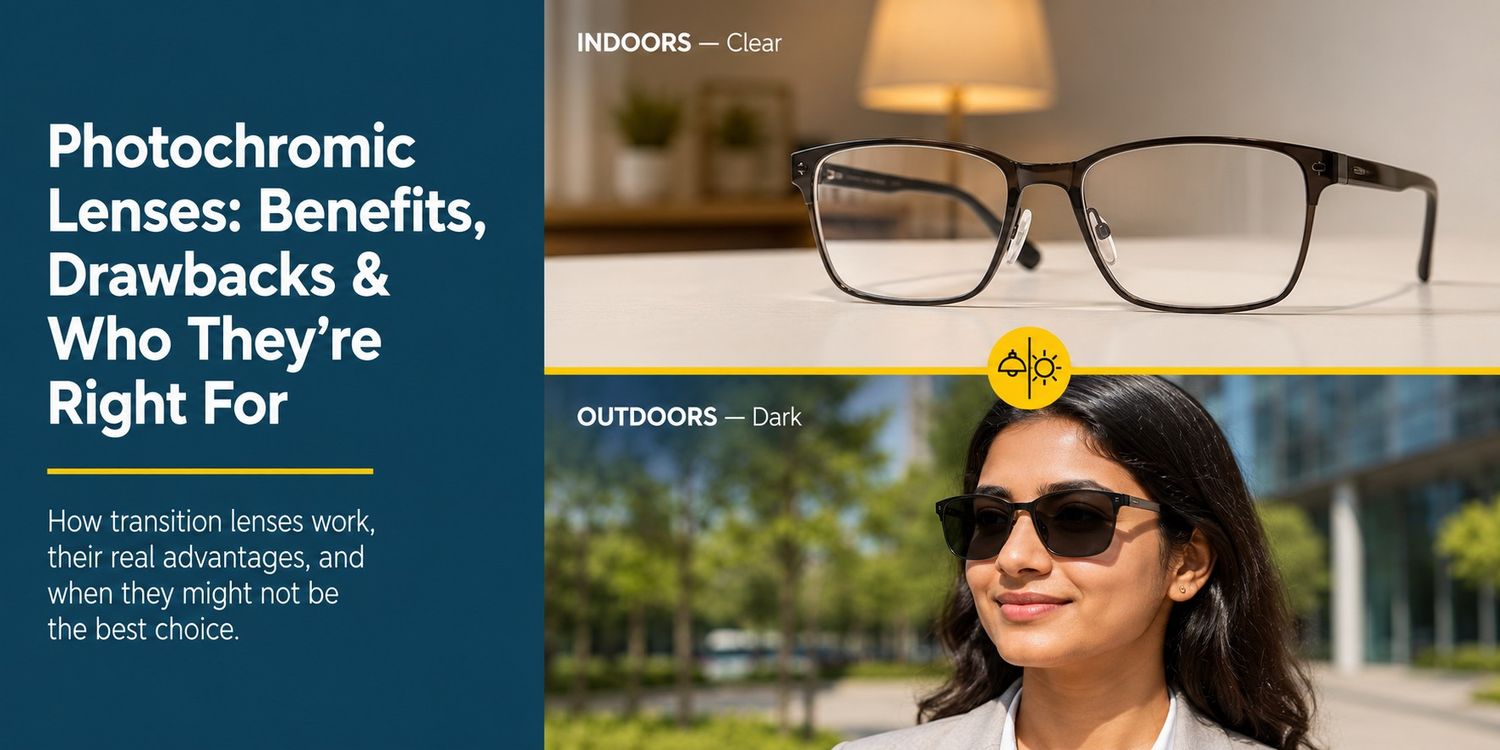
Photochromic Lenses: Benefits, Disadvantages & Who Should Use Them
Photochromic lenses, also known as transition lenses, are a revolutionary type of lens that darkens in sunlight and lightens in artificial light. This means that the user of these lenses will be able to enjoy the advantages of both eyeglasses and sunglasses. Photochromic lenses have been developed to protect the eyes from harmful UV rays while still allowing comfort in different lighting conditions.
What Are Photochromic Lenses? How Do They Work?
Photochromic lenses, also known as dimming lenses, are eyeglass lenses that automatically change colour in response to varying light levels. This revolutionary feature has effectively eliminated the need for individuals with impaired eyesight to invest in two separate pairs of glasses, one for normal use and the other for protecting their eyes from the sun’s strong rays. As a result, transition lenses have simplified the eyewear selection process.
The Science Behind Photochromic Glass
To understand what is photochromic glass, it is important for anyone looking for a smart eyewear product that changes with different light conditions, does not require additional sunglass use and provides UV protection all day long.
When you step outside into the sunlight, trillions of unique molecules incorporated in the lens material are exposed to the sun’s UV radiation. This starts a chemical reaction in which trillions of photochromic molecules contained in the photochromic lens begin to change their composition. As they change, they begin to absorb more of the visible light, causing the lens to darken. The lens usually changes to a dark grey or brown colour.
The whole process is fully reversible. As soon as you go back inside, away from the UV source, the molecules revert to their natural, transparent state. Although this is not instantaneous, it is fast enough to be a pleasant, uninterrupted visual experience.
Types of Photochromic Lenses Available in India
Photochromic lenses are available in a wide range of styles in India to suit varied visual needs and lifestyles.
The most common photochromic lenses available in India are Transitions Signature, Transitions XTRActive, and Transitions Vantage. These lenses vary in darkness, activation time, and polarisation.
In addition, several optical companies in India offer their own ranges of photochromic lenses, including single-vision, bifocal, and progressive lenses. With growing awareness of eye health and UV protection, the demand for photochromic lenses has increased manifold in India.
Benefits of Photochromic Lenses for Everyday Use
Photochromic lenses provide the perfect mix of convenience, comfort, and protection, making them the best choice as everyday eyewear for people of all ages and lifestyles. The benefits of photochromic lenses are the following:
- 1. Automatic Light Adjustment: The photochromic lenses have the advantage of adjusting to bright sunlight and becoming clear in the interior.
- 2. Protection from UV: The photochromic lenses give protection against the adverse effects of the sun’s rays.
- 3. Convenience and Cost Savings: The photochromic lenses are useful as both eyeglasses and sunglasses, hence providing the convenience of carrying only one pair of eyeglasses.
- 4. Reduced Eye Strain: The photochromic lenses have the advantage of adjusting to different lighting conditions and hence reducing eye strain.
- 5. Suitable for All Ages: Photochromic lenses are comfortable and beneficial for children, adults, and seniors of all ages. They protect your eyes in every environment and light condition.
- 6. Available in Multiple Formats: Photochromic lenses come in single vision, bifocal, and progressive lens formats.
- 7. Protects Against Blue Light: Some of these advanced photochromic lenses also protect against blue light. This is very important for people who spend long periods of time in front of computer screens.
UV Protection and Eye Comfort
They can help alleviate eye strain from high levels of light and protect against the damaging effects of UV rays. They are available as prescription glasses and sunglasses, offering a versatile option for individuals seeking both vision correction and sun protection.
Convenience of Indoor-Outdoor Transition
Photochromic lenses adjust smoothly from clear for indoor use to dark for outdoor use, thus eliminating the need for sunglasses, which is convenient for every situation
Photochromic Lenses Disadvantages: What to Know Before Buying
Even though they offer great convenience, understanding their limitations before buying them will help you make the right choice for your vision needs and lifestyle. The following are the disadvantages of photochromatic lenses:
- Slow transition in cold weather
- Do not darken inside cars
- Slower return to the clear state
- Not a complete replacement for sunglasses
- Higher cost
- Reduced effectiveness over time
- Not suitable for everyone
Slow Transition in Cold Weather
When it is cold, it takes longer for these lenses to change and turn darker, which is quite inconvenient, especially during winter or in cold countries.
Limited Use Inside Cars
Photochromic lenses are not useful in a car because the windshield blocks UV rays, preventing them from changing from transparent to dark.
Photochromic Glasses vs. Prescription Sunglasses: Which Is Better?
When it comes to choosing the right eyewear, one of the most common dilemmas people face is deciding between photochromic glasses and prescription sunglasses, as each offers distinct advantages for different situations.
Feature | Photochromic Glasses | Prescription Sunglasses |
|---|---|---|
Light Adjustment | Automatically adjusts indoors and outdoors | Fixed tint, no automatic adjustments |
UV protection | Yes, continuous UV protection | Yes, with full UV protection |
Driving | Less effective inside cars | Better suited for driving |
Convenience | One pair for all needs
Not Sure About Your Diagnosis? Book Your Appointment Now!
| Need to carry two pairs |
Cost | Expensive ones | It can be expensive too |
Darkness level | Moderate darkening | Deeper, consistent tint |
Indoor use | Clear indoors | Too dark for indoor use |
Best for | Everyday all-round use | Outdoor, driving, and sports use |
Photochromic Progressive Lenses: Best of Both Worlds?
Photochromic progressive lenses combine the advantages of photochromic lenses, which are easy to use, and progressive lenses, which are multifocal, providing a complete solution for individuals with different levels of correction for near, intermediate, and distance vision in a single pair of glasses. They are the best of both worlds, providing a complete solution without the hassle of changing pairs, while offering UV protection and comfort across different conditions.
Who Should Use Photochromic Glasses?
Photochromic glasses are appropriate for anyone who needs a convenient, all-in-one eyewear solution that combines vision correction with continuous eye protection in everyday life.
- People Who Move Frequently Between Indoors and Outdoors
If your daily routine requires constant movement between indoor and outdoor environments, photochromic glasses provide a seamless change between light conditions without the need to switch glasses.
- Students and Working Professionals
People who commute daily, attend outdoor meetings, or spend time both inside and outside can greatly benefit from the all-in-one convenience of photochromic lenses.
- Children
Photochromic lenses are a great option for kids because they provide automatic UV protection without the hassle of managing another pair of sunglasses.
- Outdoor Enthusiasts
Anyone who loves walking, hiking, cycling, or any other outdoor activities will love the continuous UV protection and glare reduction provided by photochromic lenses.
- Senior Citizens
Senior citizens who are sensitive to changes in lighting and have difficulty coping with using multiple pairs of glasses would benefit from the convenience of photochromic lenses.
- People with Light Sensitivity
People who feel uncomfortable and experience eye strain in bright light would benefit from photochromic lenses.
- Patients with Eye Conditions
Patients who experience cataracts, macular degeneration, and light sensitivity after surgery would benefit from the constant protection offered by photochromic lenses.
How to Choose the Right Photochromic Lenses
When choosing the right photochromic lenses, consider factors such as your lifestyle, prescription strength, and how much time you spend outdoors. Additionally, it is important to consider your budget as well.
Therefore, it is important to consider consulting your eye care professional, as they can help you choose the best lenses based on your vision needs. It is also important to consider factors such as transition time, darkness, blue light filtering, and lens compatibility to ensure you have chosen the best photochromic lenses.
FAQ
What are photochromic lenses, and how do they work?
Photochromic lenses, also known as dimming lenses, are eyeglass lenses that automatically change colour in response to varying light levels.
Are photochromic lenses good for driving?
Photochromic lenses are not the best option for driving, as most car windshields block the UV rays needed to activate the darkening process, making them less effective in a vehicle.
What are the disadvantages of photochromic lenses?
Photochromic lenses have several disadvantages, including slow response in cold weather, ineffectiveness in a car, higher cost than regular lenses, and a gradual loss of effectiveness over time.
Can photochromic lenses be combined with progressive lenses?
Yes, photochromic lenses can be combined with progressive lenses. The combined lenses are easy to use and, hence, progressive multifocal lenses, thereby providing a complete solution for individuals with different levels of correction for near, intermediate, and distance vision in a single pair of glasses.
How long do photochromic glasses last before replacement?
Photochromic glasses typically last between 2 and 3 years before the photochromic coating wears out and the lenses lose their ability to darken effectively, at which point replacement is recommended.