Bifocal vs Progressive Lenses: Which Is Better for Reading Vision After 40?
Around age 40, most people (including those with “perfect vision“) begin to have difficulty focusing on close objects and small print. These natural age-related changes, known as presbyopia, result from the hardening and loss of flexibility of the intraocular lens. As these changes begin, reading and focusing become more difficult, resulting in eye strain, blurred vision, and headaches.
What Is Presbyopia, and Why Does It Happen After 40?
Presbyopia is an age-related disorder that everyone experiences by the mid-40s. This is the most common reason people want vision correction with multifocal lenses. This eye condition occurs when the natural lenses in your eyes become less flexible with age.
This causes problems with your eyes’ ability to focus on nearby objects while maintaining your distance vision. This is not an illness, but rather an age-related eye condition. This eye condition affects your ability to read, use a computer, and do other things on your own.
The Early Signs of Presbyopia:
- Keeping books at arm’s length when reading
- Need to use lights to see normal things
- Eye strain after computer use
- Difficulty reading small print
- Headaches from focusing
What Is a Bifocal Lens? How Bifocals Work
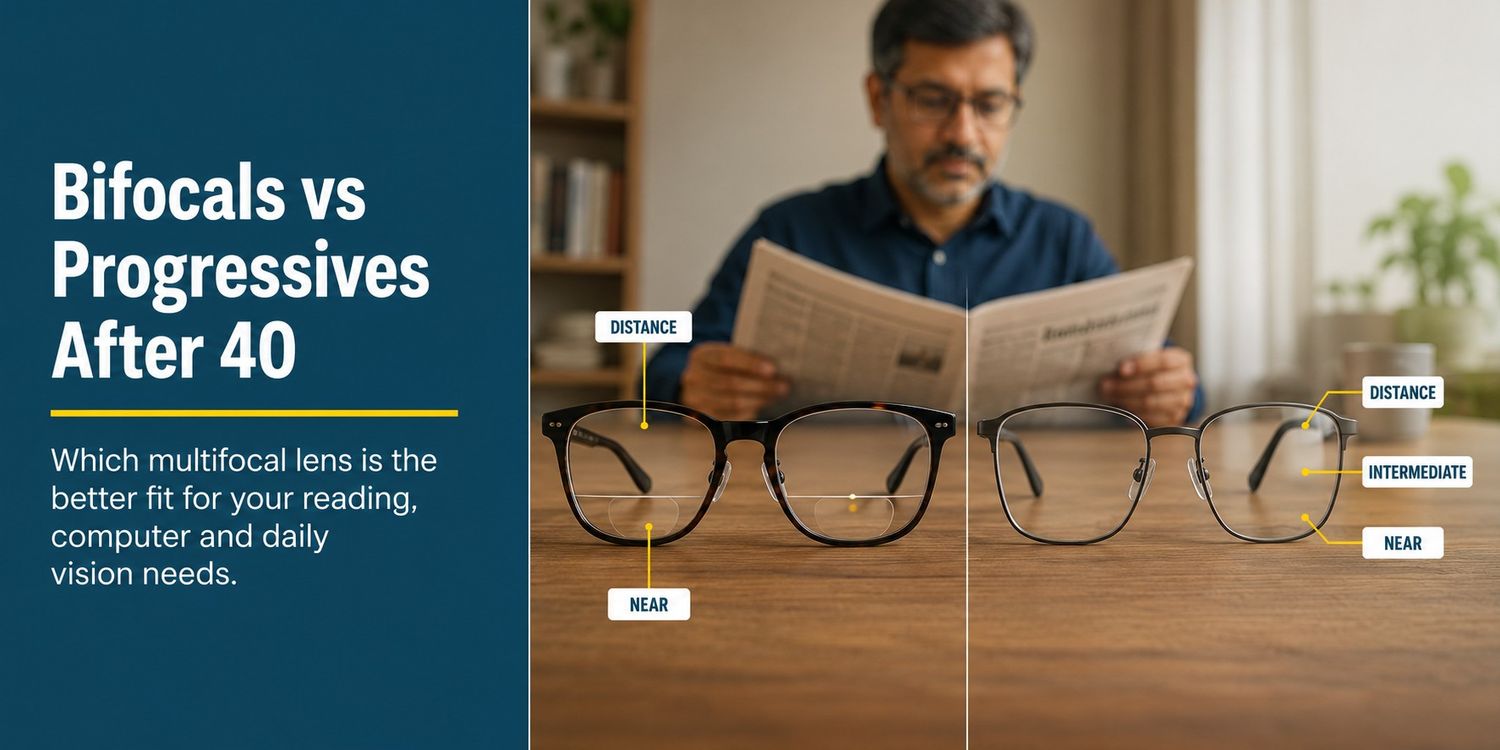
Bifocals have helped people see clearly for nearly 300 years, from Benjamin Franklin’s innovative design to modern precision-engineered solutions. These bifocal lenses have two unique prescription areas, divided by a visible line.
Traditional bifocals consist of two clearly defined sections:
- The top portion (80% of the lens) contains your prescription for driving, TV, or general activities. provides a wide, unobstructed field of view for distance vision tasks.
- Lower portion (smaller lens area): contains your prescription for reading books, newspapers, etc. A special reading area with a magnifier for close vision work.
- The distinct line between the lens areas provides a clear demarcation point, allowing you to quickly identify each activity. provides immediate and predictable visual zones.
Types of Bifocal Lenses
The various types of bifocal lenses are
- Flat-Top Bifocals (D-Segment): The most popular design with a D-shaped reading area. Offers 28 mm and 35 mm width options to suit different reading styles.
- Round Segment Bifocals: This design has a round near-vision area. This design is ideal for those who want a traditional look with maximum comfort.
- Executive Bifocals: This design has the maximum near-vision area, as the reading area covers the entire width of the lens.
Pros and Cons of Bifocal Lenses
PROS | CONS |
Many users adapt quickly. | A visible line can be cosmetically unattractive. |
Effective and inexpensive. | When switching attention, a sudden “image jump” occurs. |
Ideal for those who require clear close and distance vision exclusively. | There is no adjustment for intermediate vision (such as computer work). |
What Is a Progressive Lens? How Progressives Work
Progressive lenses, also known as “no-line bifocals,” are the newest innovation in multifocal vision correction technology. Progressive lenses, as opposed to standard bifocals with visible lines, provide a smooth, gradual transition between multiple viewing zones within a single lens.
The three distinct zones of vision provided by progressive lenses are:
- Distance zone (upper part of the lens): For driving, watching TV, looking across a room, etc.
- Intermediate zone (Middle part of lens): Computer work, dashboard reading, looking at things at arm's length, etc.
- Near zone (Lower part of lens): Reading, looking at your smartphone, etc.
The change in lens powers is gradual over the surface of the lenses to produce a smooth transition between zones of focus without the jump that bifocal lenses have.
Types of Progressive Lenses
- Standard (Conventional) Progressive Lenses: basic design with a gradual power change; less expensive, but with a narrower intermediate area
- Short Corridor Progressives: designed to fit smaller frames; faster transition from distance to near vision
- Premium (Freeform/Digital) Progressives: customised lenses with wider, clearer vision areas, and reduced distortion
- Occupational (Office) Progressives: optimised for intermediate and near vision, e.g., computer work
- Personalised Progressives: customised to individual parameters, e.g., eye position, posture, and lifestyle
- Anti-fatigue Progressives: mild power boost for near vision to reduce eye strain in younger people
Pros and Cons of Progressive Lenses
PROS | CONS |
No apparent line: more aesthetically pleasant. | More expensive than bifocal lenses |
Smooth transitions between visual zones | May necessitate a little adjusting time. |
Ideal for all-day use, including reading, driving, and computer work. | Poor lens fitting might result in visual distortion. |
Bifocal Lens vs Progressive Lens: Side-by-Side Comparison
Understanding the distinctions between bifocal lens vs. progressive lenses allows you to select the best solution based on your comfort, vision needs, and everyday lifestyle.
FEATURE | BIFOCAL LENSES | PROGRESSIVE LENSES
Not Sure About Your Diagnosis? Book Your Appointment Now!
|
Appearance | Visible line separation | No visible lines |
Vision zones | 2 (Distant, Near) | 3 (Distance, Intermediate, Near) |
Adaptation time | 3-7 days | 1-3 weeks |
Computer use | Limited (no intermediate zone) | Excellent (dedicated intermediate zone) |
Reading area | Larger dedicated segment | Smaller focused area |
Aesthetics | Traditional, functional look | Modern, youthful appearance |
Which Lens Is Better for Computer Work and Reading?
Progressive lenses have all three vision zones: far, intermediate, and near, in one lens, making them suitable for computer work and reading. Bifocal lenses have only two powers, far and near, which means computer-distance, or intermediate, vision is blurred. Progressive lenses are suitable for computer work and reading, while bifocals are suitable for reading only.
Adaptation Period: What to Expect With New Multifocal Lenses
Adjusting to new multifocal lenses takes a short time, as your eyes and brain learn to adapt to distinct zones of vision.
- It may take a few days to 1-2 weeks to get used to the new lenses
- You may experience blur, distortion, and "swim effect" at first
- You'll need to move your head and eyes to locate the correct viewing zone
- You'll need to move your head and eyes to locate the correct viewing zone
- Wearing the lenses regularly can help you adapt faster
- You'll enjoy comfort and natural vision with regular use
Cost Comparison: Bifocals vs Progressives in India
Bifocal glasses are more budget-friendly, whereas progressive glasses are more costly but provide better visual comfort and functionality.
Bifocal glasses are more budget-friendly, whereas progressive glasses are more costly but provide better visual comfort and functionality.
- Bifocal Lenses: Bifocal glasses are more reasonably priced, ranging from ₹1,000 to ₹4,000 depending on the brand.
- Progressive Lenses: These are more costly due to the technology involved in their design and provide better vision with seamless distance vision.
How to Choose the Right Lens Based on Your Lifestyle
The type of lens to be used depends on your activities, your visual needs, and your eye usage.
- For computer work: Opt for occupational or progressive lenses with a large intermediate area
- For reading, bifocal or single-vision near-vision lenses are recommended
- For wearing in all conditions: Progressives are the most convenient to wear
- For comfort and precision: Opt for premium or personalised progressive lenses
Frequently Asked Questions
What is the main difference between bifocal and progressive lenses?
The main difference is that bifocals have two distinct zones with a clear line in between. The top zone is for distance vision, and the bottom zone is for near vision. Progressives have a smooth gradient between distance, intermediate, and near vision without a clear line.
Are progressive lenses better than bifocals for daily use?
Yes, the progressive lenses are better than bifocals. They tend to be more suitable than bifocals because they can handle all distances (driving, computer use, reading) in a seamless way. However, bifocals may be more suitable for people who have difficulty adapting to progressive lenses.
Can I use bifocal lenses for computer work?
Bifocals are not ideal for computer use because the intermediate vision (at arm’s length), which is typically required to use a computer, is in the area between the distance and near zones. This means that neither zone is optimally clear. Progressives or office/computer lenses would be much more suitable.
How long does it take to adjust to progressive lenses?
Most people adapt within 1-3 weeks; however, some may need up to a month. The brain gradually learns to employ the appropriate lens zone effortlessly for each distance.
Which are more affordable, bifocal or progressive lenses in India?
Bifocal glasses are more budget-friendly, whereas progressive glasses are more costly but provide better visual comfort and functionality.