Quick Overview
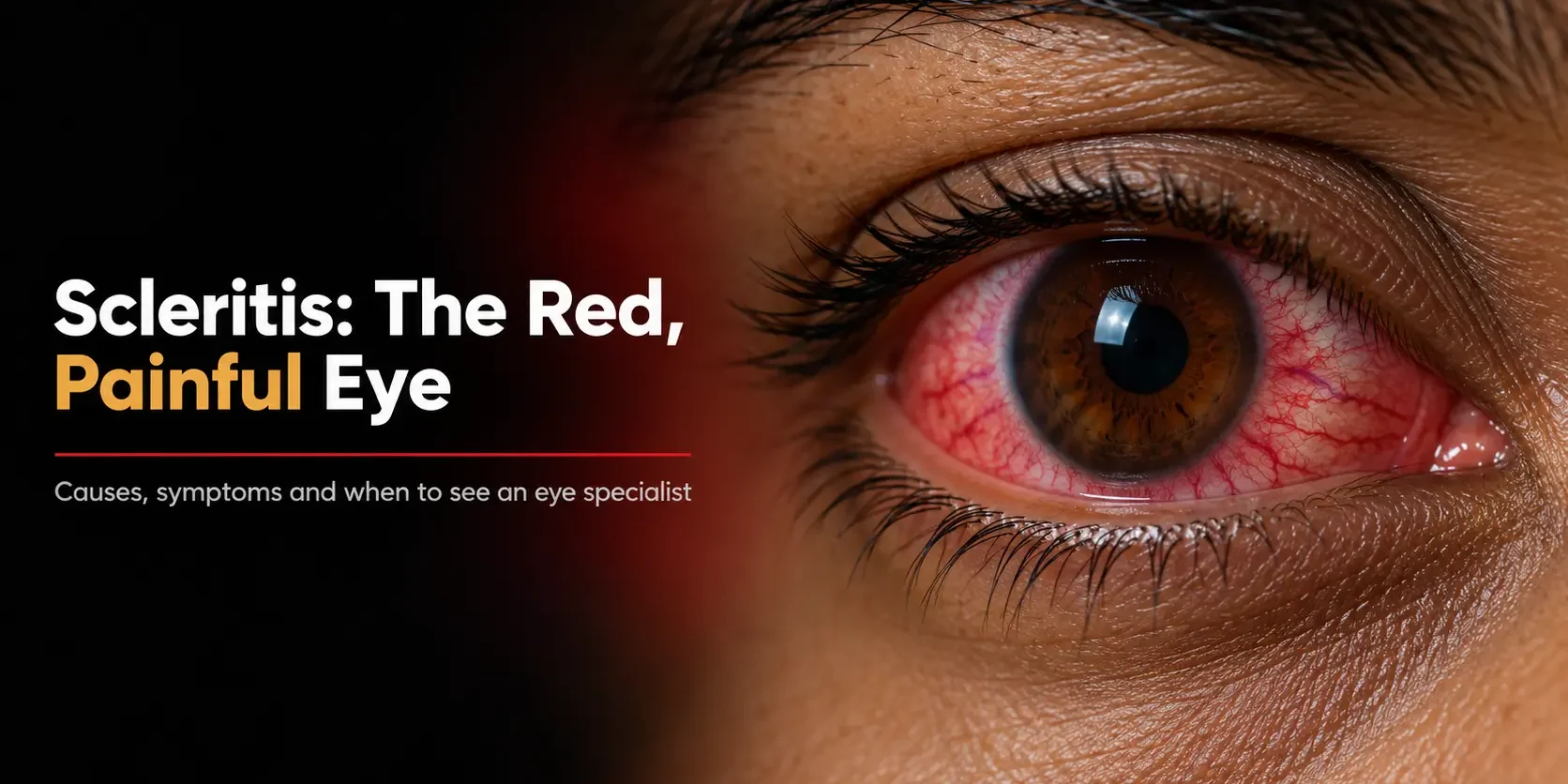
Scleritis is inflammation of the sclera, the eye’s tough, white outer wall. It typically causes deep, severe pain and redness that doesn’t resolve on its own. Scleritis often accompanies an underlying systemic condition, particularly an autoimmune disease such as rheumatoid arthritis. Prompt treatment helps protect vision.
- Pain is often severe, worse at night and felt around the eye, jaw or forehead.
- Diffuse anterior disease is most common, while necrotising disease is the most severe.
- Treatment may include anti-inflammatory medicines, corticosteroids and immunosuppressive medicines, depending on the severity and cause.
- A painful red eye with reduced vision needs same-day assessment
Introduction
A red eye is one of the most common reasons patients seek eye care, and most cases are mild. However, a red eye accompanied by deep, persistent pain warrants closer clinical attention. Pain that disturbs sleep or spreads beyond the eye can signal inflammation affecting deeper eye structures and warrants evaluation.
Scleritis is one such condition. It involves inflammation of the sclera and frequently occurs alongside an underlying systemic disease. Early recognition allows timely treatment and reduces the risk of vision-affecting complications.
Scleritis: At a Glance
| Factor | Key facts |
|---|---|
| What it is | Inflammation of the sclera, the eye’s white outer wall |
| Main symptoms | Deep pain, redness, tenderness, light sensitivity |
| Who it affects | Most often adults in middle age, more commonly women |
| Linked conditions | Rheumatoid arthritis, vasculitis, lupus, inflammatory bowel disease |
| Main treatment | Anti-inflammatory medicines, steroids, immunosuppressants |
| Urgency | Needs prompt specialist assessment |
Scleral inflammation differs from the surface redness of common eye infections. Because the sclera is a deep, structural layer, inflammation here tends to be more painful and longer-lasting.
Signs That Fit a Scleritis Eye
The most characteristic sign is pain. It is often described as deep, boring or aching, and it may spread to the forehead, temple or jaw. Many patients find it worse at night or with eye movement.
Other common signs include:
- Redness with a deep, bluish-red or violet tint
- Tenderness when the eye is touched
- Swelling of the white part of the eye in one area or across it
- Watering and sensitivity to light
- Blurred or reduced vision
Symptoms usually develop gradually over days and may affect one or both eyes. Some people notice a raised, tender lump on the white of the eye. When inflammation affects the back of the eye, redness may be minimal, while pain and blurred vision dominate.
Scleritis Causes and Autoimmune Links
At least half of cases are linked to an autoimmune condition. In these conditions, the immune system mistakenly attacks the body’s own tissues. In some patients, the eye symptoms appear before the systemic diagnosis is made.
Recognised associations include:
- Rheumatoid arthritis, the most common link
- Vasculitis (inflammation of blood vessels), including granulomatosis with polyangiitis
- Systemic lupus erythematosus
- Inflammatory bowel disease
- Relapsing polychondritis
- Infections such as shingles, tuberculosis or syphilis
- Previous eye surgery or injury
In some cases, no cause is found. This is described as idiopathic. Even then, doctors usually continue to monitor for signs of a systemic condition, as one may emerge later.
Types of Scleritis
The condition is classified by which part of the sclera is affected and how the inflammation appears.
- Diffuse anterior: widespread redness and swelling at the front of the eye. This is the most common form.
- Nodular anterior: one or more tender, raised lumps on the white of the eye.
- Necrotising anterior: a severe form in which scleral tissue can thin or break down. It has a strong association with systemic disease and carries a high risk of complications.
- Posterior: inflammation at the back of the eye, which can affect the retina and optic nerve.
Nodular anterior disease typically causes a tender, raised area. Treatment and outcome depend on the underlying cause and severity. Posterior scleritis can be harder to recognise because the front of the eye may look almost normal. The necrotising form carries the highest risk of complications and needs urgent care.
Scleritis vs Episcleritis and Pink Eye
Several conditions cause a red eye, but their severity differs considerably. Episcleritis affects the thin layer just above the sclera. Pink eye, or conjunctivitis, affects the transparent membrane covering the eye’s surface.
| Factor | Sclera (deep layer) | Episclera (surface layer) | Conjunctiva (pink eye) |
|---|---|---|---|
| Pain | Deep, often severe | Mild discomfort | Mild irritation or grittiness |
| Redness | Deep, bluish-red, violet | Bright red, often patchy | Pink or red, widespread |
| Discharge | Usually none | Usually none | Common |
| Vision | May be reduced | Usually normal | Usually normal |
| Course | Requires prompt assessment and treatment | Often settles on its own | Depends on the cause |
The key difference when comparing episcleritis and the deeper condition is pain. A red eye that is truly painful, tender or affects vision should not be treated as simple irritation.
Diagnosis and Eye Exam
Diagnosis begins with a detailed history and a careful eye examination. An eye specialist uses a slit lamp, a magnifying microscope, to inspect the eye’s layers.
- Visual examination in daylight to assess the colour and depth of redness
- Slit-lamp examination to identify which layer is inflamed
- A phenylephrine blanching test may help distinguish episcleritis from scleritis because superficial vessels generally blanch in episcleritis, whereas deeper vessels do not.
- Ultrasound or MRI scans when the back of the eye may be involved
- Blood tests and a chest X-ray to look for linked autoimmune conditions or infection
Because systemic disease is common, assessment often involves a rheumatologist (a specialist in autoimmune and joint conditions). Test results help guide the most suitable treatment.
Scleritis Treatment Options
Treatment aims to control inflammation, relieve pain and protect the eye. It also addresses any underlying condition. Care is usually stepped up according to severity.
- Anti-inflammatory tablets (NSAIDs) for mild to moderate disease
- Steroid tablets or steroid eye drops when NSAIDs are not enough
- Immunosuppressant medicines for persistent or recurrent disease
- Biologic medicines, which target specific parts of the immune system, for severe cases
- Antimicrobial treatment when an infection is the cause
- Surgery, occasionally, to repair severe scleral thinning
These medicines require careful monitoring and should be taken only as prescribed. Self-treatment with over-the-counter eye drops is not appropriate.
Recovery, Complications and Prognosis
Recovery depends on the type, severity and underlying cause. Mild to moderate disease often responds well, with symptoms improving over several weeks. Some patients need longer treatment, and the disease can recur.
Possible complications include:
- Thinning of the sclera or cornea
- Raised eye pressure or glaucoma
- Cataract
- Uveitis, inflammation inside the eye
- Reduced vision, particularly with necrotising or posterior disease
Regular follow-up allows the specialist to adjust treatment and monitor for these changes. Patients with an associated autoimmune condition also benefit from coordinated care between their eye specialist and physician. Treating an associated systemic condition is an important part of care and may help control ocular inflammation.
When a Red, Painful Eye Is Urgent
Seek same-day assessment by an eye specialist if a red eye comes with:
- Severe or worsening pain, especially pain that wakes you at night
- Reduced or blurred vision
- Marked sensitivity to light
- Tenderness when touching the eye
- A known autoimmune condition such as rheumatoid arthritis
Do not wait for redness to settle on its own when pain is significant. Avoid using leftover or borrowed eye drops, as some can mask symptoms or worsen certain conditions.
Conclusion
Scleritis is an uncommon but significant cause of a red, painful eye. Its deep pain, tenderness and frequent links to autoimmune disease set it apart from common surface conditions.
With timely diagnosis and appropriate treatment, most patients achieve good inflammation control. Any red eye with significant pain or changing vision deserves prompt specialist assessment rather than home management.
Disclaimer: This article is for general information only and is not a substitute for professional medical advice. Please consult an eye specialist promptly to discuss your specific symptoms.
FAQs
How Serious is Scleritis?
It is considered a serious eye condition because untreated inflammation can damage the eye and affect vision. It may also signal an underlying autoimmune disease.
Can Scleritis Go Away Without Treatment?
It rarely settles fully without treatment. Medical care is needed to control inflammation, relieve pain and prevent complications. Delaying treatment increases the risk of lasting eye damage.
Is Scleritis an Emergency?
It needs urgent, same-day assessment, particularly with severe pain or reduced vision. Necrotising and posterior forms carry the highest risk.
How Long Does Scleritis Take to Heal?
Many cases improve over several weeks with treatment. Some patients need treatment for months, and recurrences are possible. Doctors usually taper medications gradually once inflammation subsides.
What is the Most Common Type of Scleritis?
Diffuse anterior disease is most common. It causes widespread redness and inflammation at the front of the eye. It generally responds well to treatment.
Can Episcleritis Turn Into Scleritis?
They are generally considered separate conditions, and progression is uncommon. However, early deeper inflammation can resemble episcleritis, so worsening pain needs review.
References
AAO. (2019, November 15). What is scleritis? American Academy of Ophthalmology. https://www.aao.org/eye-health/diseases/what-is-scleritis
Lagina, A., & Ramphul, K. (2023, June 26). Scleritis. StatPearls Publishing. PubMed. https://www.ncbi.nlm.nih.gov/books/NBK499944/