How Does Laser Eye Surgery Work? Everything You Need to Know
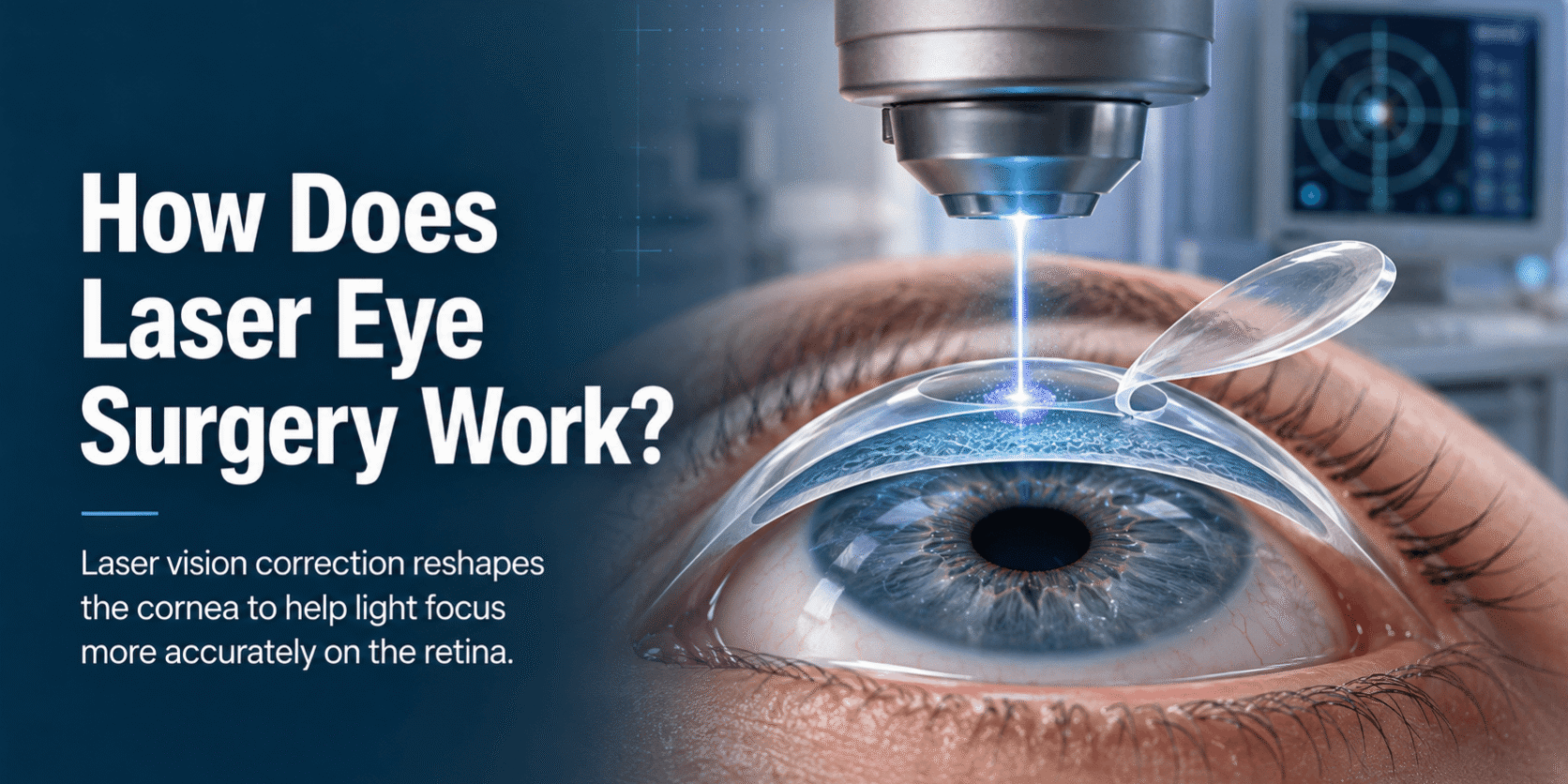
Laser eye surgery is a type of refractive surgery designed to reduce dependence on glasses or contact lenses. If you are wondering how laser eye surgery works, the basic principle is to reshape the cornea, the clear front surface of the eye, so that light focuses more accurately on the retina.
Different procedures can reshape the cornea in different ways. LASIK and PRK are two commonly known laser vision correction procedures, but they differ primarily in how the surgeon reaches the corneal tissue to be treated.
How Does Laser Eye Surgery Work?
The cornea provides much of the eye’s focusing power. When its shape causes light to focus incorrectly, it can result in refractive errors such as nearsightedness, farsightedness, or astigmatism. Laser eye surgery changes the shape of the cornea to help correct this focusing problem.
In LASIK, a computer-controlled excimer laser removes very small amounts of corneal tissue according to the patient’s eye measurements. This precise reshaping changes the focusing power of the cornea.
What Happens During LASIK?
A typical LASIK procedure involves several steps:
- Eye examination and measurements: Before surgery, an ophthalmologist performs a detailed eye examination to determine whether laser vision correction is appropriate and to measure the eyes for treatment planning.
- Numbing the eye: Anaesthetic eye drops are used to numb the eye’s surface.
- Creating a corneal flap: In LASIK, the surgeon creates a thin flap in the cornea. This can be done using a mechanical microkeratome or a femtosecond laser.
- Reshaping the cornea: The flap is gently moved aside, exposing the underlying corneal tissue. An excimer laser then precisely removes microscopic amounts of tissue to reshape the cornea.
- Replacing the flap: The corneal flap is placed back into its original position, where it begins to heal without stitches.
The laser treatment itself is computer-controlled and based on measurements taken during the preoperative assessment.
How is PRK Different From LASIK?
PRK also uses an excimer laser to reshape the cornea, but it does not involve creating a LASIK flap.
In PRK, the thin outer layer of the cornea, called the epithelium, is removed to expose the underlying tissue. The excimer laser then reshapes the cornea. The surface layer gradually grows back during healing.
The choice between LASIK, PRK, or another vision correction procedure depends on factors such as corneal thickness and shape, eye health, prescription, tear-film health, lifestyle, and the surgeon’s assessment.
Who May Be Suitable for Laser Eye Surgery?
Not everyone is a suitable candidate. A comprehensive eye examination is important before making a decision.
Your ophthalmologist may evaluate:
- Stability of your glasses or contact lens prescription
- Corneal thickness and shape
- Tear production and dry-eye symptoms
- Overall eye health
- Existing eye conditions or previous eye surgery
- General health and factors that may affect healing
Certain conditions, including some corneal diseases and uncontrolled or relevant medical conditions, may make laser vision correction unsuitable or require additional assessment.
What Can You Expect After Laser Eye Surgery?
Vision may be blurry or fluctuate during the early healing period. Some people experience temporary dryness, glare, halos, or difficulty with night vision. Vision can continue to stabilise over the following months.
Your ophthalmologist may prescribe eye drops and provide specific instructions about protecting your eyes, avoiding rubbing them, and temporarily limiting activities such as swimming or contact sports. Following these instructions can support proper healing.
Laser eye surgery can reduce dependence on glasses or contact lenses, but it does not guarantee that a person will never need glasses again. Some people may still require glasses for certain activities, and age-related changes, such as presbyopia, can affect near vision later in life.
What are the Risks of Laser Eye Surgery?
Like any surgical procedure, laser vision correction has potential risks. These can include dry eyes, glare, halos, difficulty with night vision, undercorrection or overcorrection, and other visual symptoms. In uncommon cases, more serious complications can occur.
For this reason, laser eye surgery should be considered only after a detailed discussion with a qualified ophthalmologist about its potential benefits, risks, alternatives, and whether it is appropriate for your eyes.
Key Takeaways
- Laser eye surgery works by reshaping the cornea to improve how light focuses on the retina.
- LASIK uses an excimer laser to reshape corneal tissue beneath a thin flap.
- PRK also reshapes the cornea with an excimer laser but does not create a LASIK flap.
- A detailed eye examination is necessary to determine whether you are a suitable candidate.
- Recovery and vision stabilisation vary between patients and procedures.
- Laser eye surgery can reduce dependence on glasses or contact lenses, but results and risks vary from person to person.
Conclusion
Understanding how laser eye surgery works starts with understanding the role of the cornea in focusing light. Procedures such as LASIK and PRK use precise laser technology to reshape the cornea and correct certain refractive errors.
However, laser vision correction is not suitable for everyone, and there is no guaranteed outcome. If you are considering laser eye surgery, consult a qualified ophthalmologist for a comprehensive eye examination and personalised advice about the most appropriate treatment for your eyes.