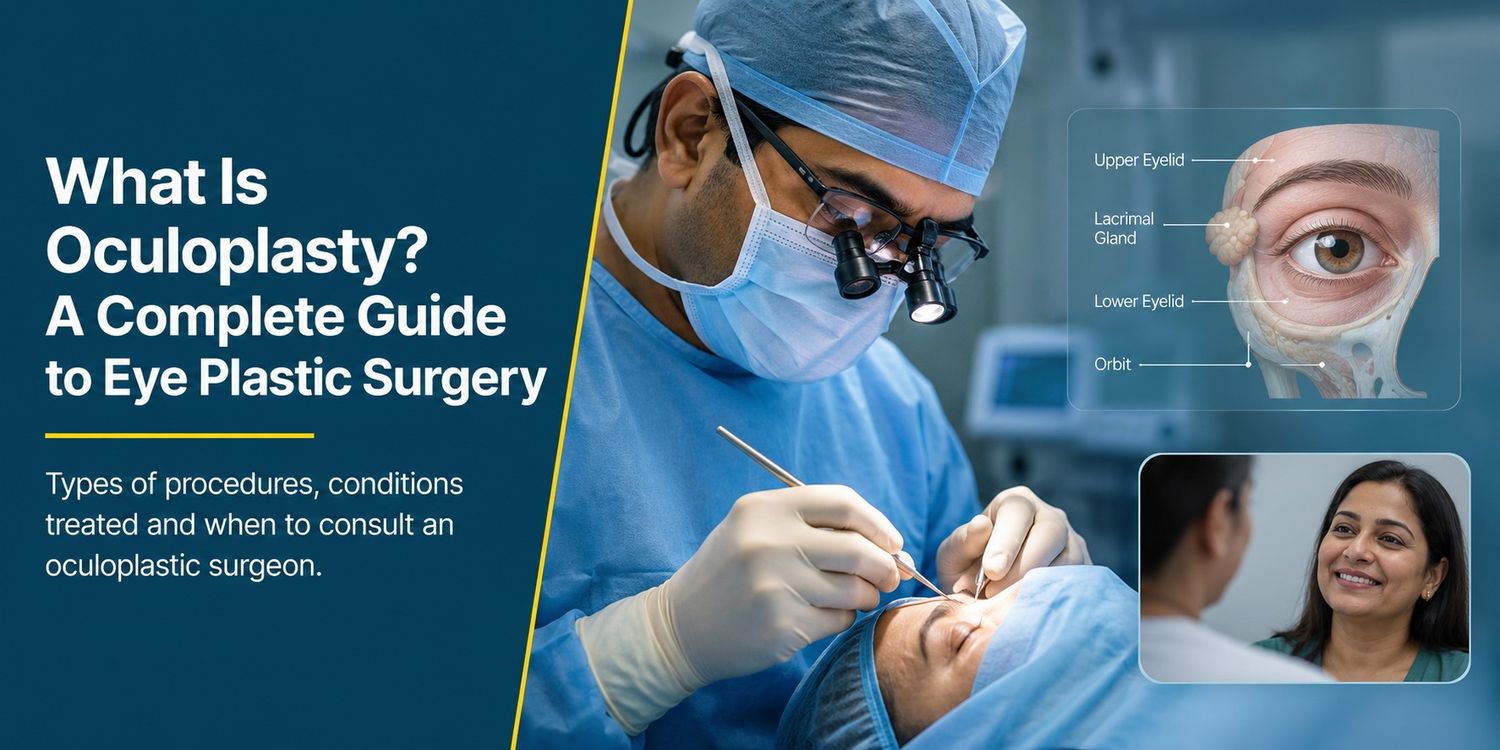
What Is Oculoplasty? Types, Procedures & When You Need an Oculoplastic Surgeon
Most people are familiar with eye doctors who check vision and treat conditions like cataracts or glaucoma. But there is a separate subspecialty within ophthalmology that deals with the structures around the eye. This subspecialty is called oculoplasty, and the doctors who practise it are called oculoplastic surgeons.
What Does an Oculoplastic Surgeon Do? Scope of Practice Explained
An oculoplastic surgeon is an ophthalmologist who has done additional specialised training in plastic and reconstructive surgery of the eye, as well as its surrounding structures. This dual training is important; they understand the eye as an organ deeply, and they also have the surgical skills to work on delicate surrounding tissues without compromising vision or eye function.
So the scope is both medical and surgical, both functional and cosmetic. This is what makes the speciality different from a regular eye clinic.
When Should You See an Oculoplasty Surgeon vs a General Eye Doctor?
A general ophthalmologist handles most routine and common eye conditions, refractive errors, cataracts, glaucoma, diabetic eye disease, and infections. For anything involving the physical structure of the eyelids, the tear drainage system, or even the eye socket itself, an oculoplastic surgeon is more appropriate.
Some situations that specifically warrant an oculoplastic surgery referral: one or both upper eyelids drooping noticeably, persistent watering from the eye that has not responded to drops, a lump or swelling near or behind the eye, sunken or bulging eyes, difficulty closing the eyelid fully, any injury that has affected the eye socket or eyelid structure, and changes in the appearance of the eye area following thyroid disease.
Oculoplasty Meaning: What the Speciality Covers and Why It Matters
The word comes from “oculo”, meaning eye and “plasty”, meaning surgical repair or reshaping. Oculoplasty as a field exists because the eye is surrounded by structures that are functionally important: the eyelids protect the eye surface, the tear ducts drain fluid properly, the orbit houses and protects the eyeball, and when any of these structures malfunction or are damaged, it affects the eye itself.
A drooping eyelid is not just an appearance issue. If the lid covers a significant portion of the pupil, it can obstruct vision and, in children, cause amblyopia (lazy eye) if not corrected in time. Similarly, a blocked tear duct is not just an inconvenience; chronic watering can lead to infection and affect the quality of the corneal surface over time.
This is why oculoplastic surgery matters; it is not a cosmetic luxury. Many of the procedures done in this speciality are medically necessary.
Common Types of Oculoplastic Surgery
Eyelid Surgery (Blepharoplasty) for Drooping or Excess Skin
Blepharoplasty refers to surgery on the eyelids to remove excess skin, fat, or muscle. In older patients, the skin of the upper eyelid can become loose and hang over the lid margin, sometimes to the point of blocking vision. Lower eyelid bags, the puffy appearance under the eyes, can also be corrected with blepharoplasty.
Laser Eye Surgery Recovery Time: What the First Week Looks Like
Ptosis Correction: Treating a Drooping Upper Eyelid
Ptosis is a condition where the upper eyelid droops lower than it should, sometimes slightly, sometimes enough to cover a significant part of the pupil.
The treatment involves tightening or reattaching the muscle responsible for lifting the eyelid, called the levator muscle.
Best Laser Eye Surgery in India: What Makes a Clinic Stand Out
Orbital Surgery: Treating Tumours, Fractures and Thyroid Eye Disease
The orbit is the bony cavity that houses the eyeball. Problems within the orbit, tumours, infections, fractures from trauma, or the inflammation associated with thyroid eye disease require surgery that is both delicate and precise.
Orbital fractures from road accidents or falls may require repair to restore the normal anatomy of the eye socket and prevent long-term double vision or sunken eye appearance.
Lacrimal (Tear Duct) Surgery for Blocked Tear Ducts
Tears drain from the eye through small openings at the inner corner of the eyelids into a duct system that eventually leads into the nose. When this drainage pathway is blocked, tears overflow onto the cheek, and the eye becomes prone to repeated infections.
The surgical treatment is called dacryocystorhinostomy, or DCR. A new drainage passage is created between the tear sac and the nasal cavity, bypassing the blockage. It can be done externally (with a small skin incision) or endoscopically through the nose.
What to Expect Before, During, and After Oculoplasty Surgery
Before oculoplastic surgery, your oculoplastic surgeon will do a detailed examination; this may include imaging (CT scan or MRI) for orbital conditions, measurement of eyelid position and function for ptosis, or probing and irrigation of the tear duct system for lacrimal problems.
Most oculoplastic procedures are done under local anaesthesia with sedation, or general anaesthesia for more complex orbital surgeries or for children. Procedures like ptosis correction as well as blepharoplasty are usually day-care; you go home the same day.
After surgery, swelling and bruising around the eye area are expected for the first one to two weeks. Cold compresses, head elevation, and antibiotic ointment or drops are usually part of the immediate post-operative care.
Oculoplasty Recovery: Timeline, Aftercare and What Results to Expect
For eyelid procedures like blepharoplasty or ptosis correction, swelling and bruising peak around day two to three and then gradually reduce. Most patients look presentable within two weeks. Final results, including scar fading and complete swelling resolution, take two to three months.
For lacrimal surgery, the eye may water slightly more than usual initially, which settles as healing progresses. Nasal packing, if used, is removed within a day or two.
Orbital surgeries have longer recovery timelines depending on the extent of the procedure. Full return to normal activity may take four to six weeks.
Avoiding strenuous activity, bending forward, and rubbing the eye area is important in the first few weeks. Follow-up visits are part of the recovery process and should not be skipped.
How to Choose the Right Oculoplasty Surgeon for Your Condition
Look for an ophthalmologist who has completed a recognised fellowship in oculoplasty after their MD or MS in ophthalmology.
Experience of an oculoplastic surgeon matters significantly in this speciality; the outcomes of eyelid and orbital surgery are closely linked to the oculoplasty surgeon’s familiarity with the anatomy and the volume of cases they have done.
Frequently Asked Questions: Oculoplasty and Oculoplastic Surgery
What is the difference between oculoplasty and regular eye surgery?
Regular eye surgery, cataract removal, glaucoma surgery, and retinal procedures deal with the eyeball itself. Oculoplasty deals with the structures around the eye.
Is oculoplastic surgery covered by insurance in India?
It depends on the condition as well as the insurer. Check with your insurer and get a pre-authorisation if possible.
How long does oculoplasty surgery take?
This varies by procedure. Ptosis correction and blepharoplasty typically take 45 minutes to 1.5 hours.
Can oculoplasty improve vision?
In some cases, yes. If ptosis is causing the eyelid to obstruct the pupil, correcting it improves the visual field directly.
What qualifications should an oculoplastic surgeon have?
An oculoplasty surgeon should be an MBBS with an MS or MD in Ophthalmology, followed by a recognised fellowship in Oculoplasty and Facial Aesthetics. Membership in professional bodies like the Indian Society of Oculoplasty is an additional indicator for an oculoplastic surgeon.