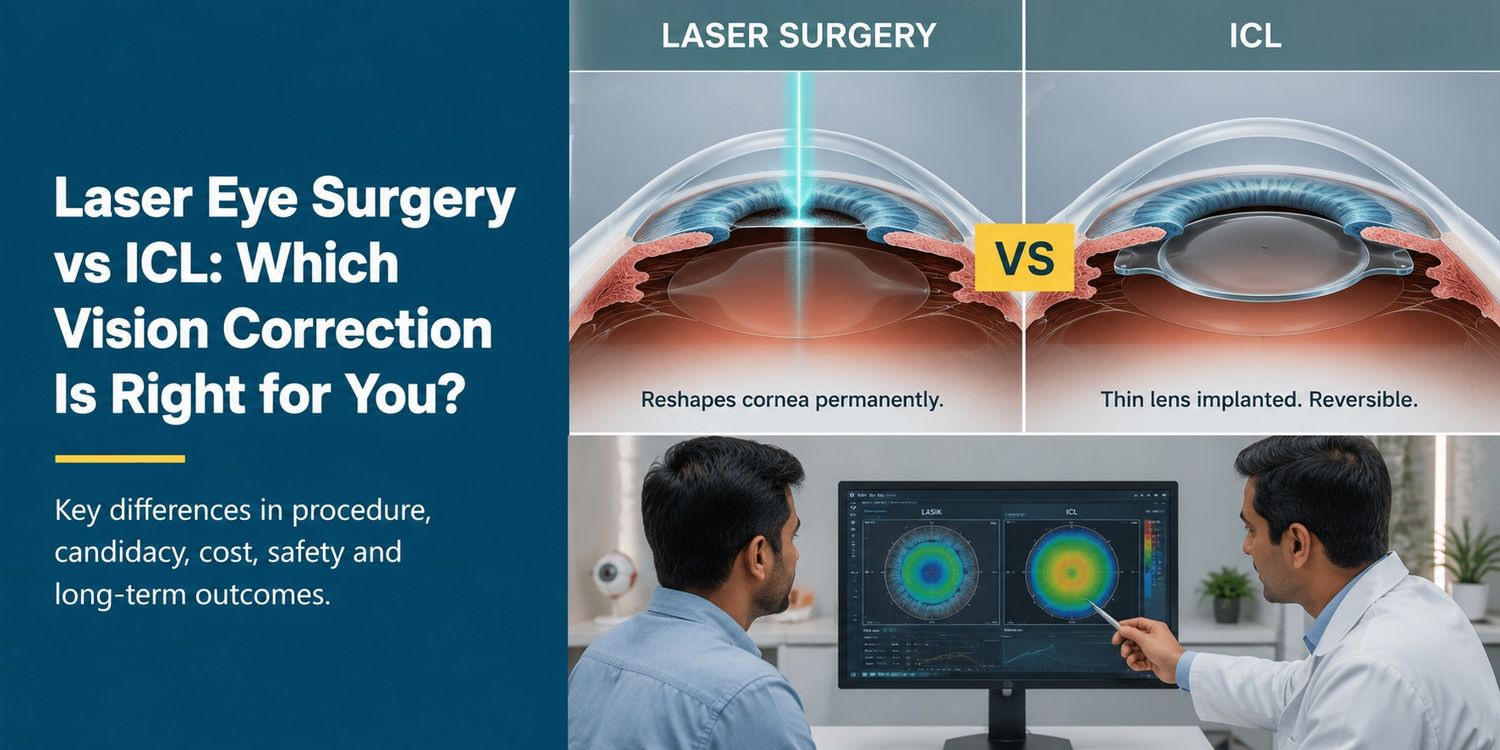
Laser Eye Surgery vs Implantable Contact Lens (ICL): Key Differences
People who want to stop wearing glasses or contact lenses usually come across two main options: laser eye surgery or an implantable contact lens. Both can give you good vision without glasses, but they work very differently and are suitable for different types of patients. This article covers both options clearly.
EVO ICL Surgery: The Next Generation of Implantable Contact Lens
EVO ICL is the current version of the implantable collamer lens made by STAAR Surgical. It is an improvement over the older ICL design in one important way: it has a small central hole called a KS-Aquaport. This tiny opening allows the natural fluid inside the eye to circulate freely.
The EVO ICL is made from Collamer. Because it does not touch the natural lens directly, the risk of cataract formation is lower.
ICL vs LASIK: Which Is Better? Comparing Safety, Results and Candidacy
LASIK permanently reshapes the cornea using a laser. It works well for mild to moderate prescriptions and requires adequate corneal thickness. ICL does not touch the cornea at all; a lens is simply added inside the eye. Because it is additive rather than subtractive, ICL preserves the cornea completely.
For patients with thin corneas, very high minus power, or dry eyes that make laser surgery risky, ICL is typically the safer and more appropriate option. For patients with moderate prescriptions and healthy, thick corneas, LASIK gives excellent results at a lower cost.
Visual quality after ICL is often described as very sharp and natural, particularly in dim light and at night. This is partly because the ICL does not alter the corneal shape, so there is less distortion of the optical system. Some patients with high power who had LASIK and then got ICL report preferring ICL, though individual experiences vary.
What Is Laser Surgery for Eyes? Types and How Each Works
Laser eye surgery is a broad term covering several procedures that reshape the cornea to correct refractive errors.
LASIK involves creating a thin flap on the corneal surface, using an excimer laser to reshape the underlying tissue, and repositioning the flap.
SMILE does not create a flap. A femtosecond laser creates a small disc of tissue inside the cornea, which is then removed through a tiny incision.
PRK (Photorefractive Keratectomy) is an older surface-based procedure where the outer corneal layer is removed, and the laser is applied directly to the surface.
How Much Does Laser Eye Surgery Cost in India?
Standard femto-LASIK (bladeless) typically costs between Rs. 25,000 and Rs. 45,000 per eye. SMILE surgery is more expensive, roughly Rs. 50,000 to Rs. 90,000 per eye. PRK is generally in a similar range to standard LASIK or slightly less.
ICL surgery costs more, typically Rs. 80,000 to Rs. 1,50,000 per eye, depending on the lens type and centre. EVO ICL with toric correction (for astigmatism) is at the higher end.
Laser Eye Surgery Recovery Time: What the First Week Looks Like
LASIK recovery is quite fast. Most patients see clearly by the next morning. There may be some watering, mild sensitivity to light, and a gritty feeling on the day of surgery.
SMILE recovery is slightly slower in the first two to three days but tends to be more comfortable because there is less surface disruption.
PRK has the slowest recovery. Vision may be blurry and uncomfortable for the first four to five days. Full visual stability can take a month or more.
For ICL surgery, recovery is reasonably quick too. Vision improves within a day or two in most cases. There may be some sensitivity and mild halos around lights in the first week.
Best Laser Eye Surgery in India: What Makes a Clinic Stand Out
A good refractive surgery centre is about thorough screening, experienced surgeons, and honest counselling.
Things worth looking for: availability of detailed pre-operative evaluation: corneal topography and dry eye assessment, track record of the surgeon performing the procedure, availability of multiple procedure options, and clarity on post-operative follow-up included in the package.
Laser Eye Surgery Age Requirements: Who Is Eligible?
Most refractive surgeons in India recommend waiting until the age of 18 at minimum, and many prefer 21 for laser surgery. The more important requirement is that your prescription should be stable, not changing, for at least one to two years before surgery.
For ICL, the approved age range is typically 21 to 45 years. Below 21, the eye may still be changing. Above 45, presbyopia starts becoming relevant, and the surgical plan needs to account for it.
Life After Laser Eye Surgery: What to Expect in the Long Term
Laser eye surgery gives stable results for many years. The corneal reshaping is permanent. However, a small percentage of patients, particularly those with higher prescriptions, may experience some regression over time. In such cases, an enhancement procedure may be possible if there is adequate corneal tissue remaining.
Is Laser Eye Surgery Safe? Clinical Evidence and Success Rates
Serious complications from LASIK are uncommon: infection, significant flap complications, or vision worse than before surgery happen in a small minority of cases when proper screening is done.
The most common issue patients report is dry eye after LASIK, which usually improves within three to six months. SMILE has a lower reported incidence of post-operative dry eye.
ICL safety data is also strong. Cataract formation, elevated eye pressure, and endothelial cell loss (affecting the inner layer of the cornea) are the main long-term concerns monitored with ICL.
What Is an Implantable Contact Lens?
An implantable contact lens is a small, soft synthetic lens placed surgically inside the eye, between the iris and the natural crystalline lens.
Implantable Contact Lens Pros and Cons
The main advantages of ICL are that it corrects a wider range of prescriptions, does not thin the cornea, and can be removed if needed. Visual quality, particularly at night, is often very good.
The limitations are cost, the need for regular long-term follow-up, and the fact that it requires adequate space inside the eye.
Who Is a Candidate for Implantable Contact Lens Surgery?
Good ICL candidates have moderate to high myopia (roughly -6 to -20 dioptres), a stable prescription for at least a year, adequate anterior chamber depth, healthy endothelial cell count, and no significant eye disease.
Frequently Asked Questions: Laser Eye Surgery vs ICL
Can I switch from ICL to laser eye surgery later?
Yes, it is possible as long as your cornea has sufficient thickness.
What is the minimum age for laser eye surgery in India?
Most centres in India set the minimum at 18 years, with many preferring 21.
Is ICL better than laser surgery for high minus power?
Generally yes. For high minus power with an otherwise suitable eye profile, ICL is usually the recommended option.
How long do results from laser eye surgery last?
The corneal reshaping from laser surgery is permanent. A small percentage may experience some power regression over time.
Which is more affordable, laser eye surgery or ICL in India?
Laser eye surgery is significantly more affordable. However, cost should not be the only deciding factor.