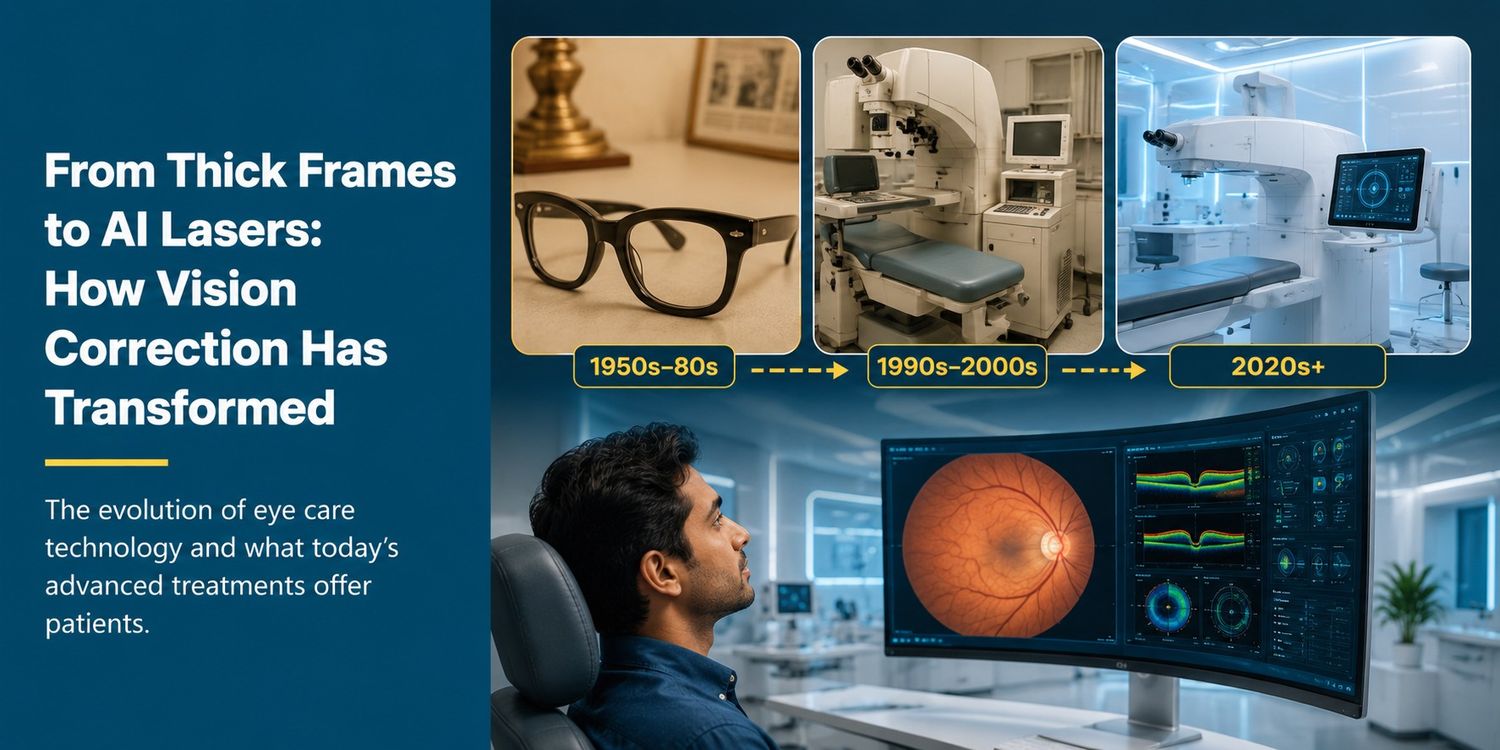
How Modern Technology Has Transformed Vision Correction
Eye care in India has changed quite a lot over the last ten to fifteen years. The equipment used, the accuracy of measurements, and the way surgeries are planned, all of it has moved forward considerably. This article looks at how modern technology, particularly femtosecond lasers, corneal mapping, AI-based diagnostics, and remote eye care, has changed the way vision problems are detected and corrected.
Topography-Guided LASIK: Customising Surgery to Your Unique Cornea Map
No two corneas are exactly alike. Even your left and right eyes have slightly different surface shapes. Standard LASIK uses your spectacle prescription as the primary guide; it corrects the overall power of the eye but does not account for subtle irregularities in the corneal surface.
Topography-guided LASIK goes a step further. Before surgery, a detailed map of your corneal surface is created using a device called a corneal topographer. This map captures thousands of data points from across the cornea and identifies any irregularities, areas that are steeper or flatter than they should be, and zones that scatter light differently.
This map is then fed into the laser system. The laser smooths out surface irregularities that can cause issues like glare, halos, or reduced contrast sensitivity. For people who had less than perfect outcomes with standard LASIK, topography-guided treatment has been used as an enhancement procedure with good results.
It is generally recommended for patients with mild irregular astigmatism or those who have had previous eye surgery that has altered the corneal shape.
Refractive Surgery Meaning: What It Is and How Modern Tech Has Changed It
Refractive surgery refers to any surgical procedure that aims to reduce or eliminate dependence on glasses or contact lenses by changing the way the eye focuses light. The cornea, the lens inside the eye, or both may be involved, depending on the type of surgery.
LASIK, SMILE, PRK, and implantable collamer lens (ICL) surgery are all types of refractive surgery. Each corrects the path of incoming light so it hits the retina more accurately.
Earlier, blade-based instruments were used to create corneal flaps in LASIK. The results were generally good, but there was some variability in flap thickness and shape. Femtosecond lasers replaced the blade for this step, allowing far more controlled and consistent flap creation.
Similarly, diagnostic tools have become much more accurate. Wavefront analysers measure optical imperfections in your eye that are not captured in a regular prescription. Optical coherence tomography (OCT) allows detailed imaging of the cornea and retina in cross-section.
Eye Care in 2026: How Advanced Technology Is Reshaping Treatment
Retinal imaging that earlier required dilation of the pupil can now, in many cases, be done without drops, using wide-field fundus cameras. AI algorithms are being used to analyse retinal photographs for early signs of diabetic retinopathy, glaucoma, and age-related macular degeneration.
For patients with conditions like keratoconus, early detection has dramatically improved. Corneal tomography devices can now detect very early keratoconus before it becomes clinically obvious, allowing for timely intervention.
Intraocular lens (IOL) power calculation for cataract surgery has also become significantly more accurate. Newer generation formulas combined with optical biometry have reduced the incidence of post-cataract refractive surprises, situations where the patient ends up needing glasses of a different power than expected after surgery.
What to Expect at a Technology-Forward Vision Centre
If you walk into a well-equipped eye hospital today, the pre-operative evaluation process is quite thorough. For a refractive surgery consultation, you might go through eight to ten different measurements across two to three machines, corneal topography, pachymetry (corneal thickness), wavefront analysis, dry eye assessment, and more.
One of the most important things refractive surgery evaluation does is identify patients who should not undergo the procedure.
Femtosecond laser platforms are updated regularly and deliver energy in pulses measured in femtoseconds, that is, one quadrillionth of a second.
Post-operative follow-up at good centres now includes objective measurements, corneal topography after surgery to confirm the treatment zone, dry eye assessments, and contrast sensitivity testing.
Tele-Optometry: How Remote Eye Care Is Becoming a Reality
Tele-optometry means the use of digital tools and video consultations to deliver basic eye care remotely. Basic vision screening, follow-up consultations after surgery, prescription renewals, and counselling can all be done remotely to some extent.
Some platforms now allow patients to upload photos of their glasses prescription and get a basic vision check done through an app-based tool. While these cannot replace a full clinical examination, they serve a screening and convenience function, helping people who might otherwise ignore early symptoms to at least get a basic assessment.
Visual Field Test and AI Diagnostics: Seeing What the Human Eye Misses
A visual field test measures how much of your field of vision is intact, not just straight ahead, but to the sides, above, and below. It is an important test for conditions like glaucoma.
AI is now being used to analyse visual field results more reliably. One problem with visual field testing is variability. AI tools that analyse multiple tests together and separate true progression from variability are helping clinicians make better decisions about treatment timing.
From Blade to Femtosecond Laser: A Decade of Progress in Eye Surgery
Ten years ago, bladeless LASIK was available but not as widespread in India. Results were good, but flap-related complications, though rare, did occur.
The widespread adoption of femtosecond lasers for flap creation reduced this variability. The laser creates a flap of much more predictable thickness and shape, with a more even edge.
SMILE surgery itself became possible only because of femtosecond laser technology. The entire procedure depends on the laser’s ability to work precisely within corneal tissue without damaging the surface.
For cataract surgery, femtosecond lasers are now also available for certain steps.
Are Tech-Driven Eye Surgeries Safer Than Traditional Methods?
Generally, yes, but with some important qualifications. Technology improves precision, reduces human variability, and provides better information for decision-making. All of this tends to improve safety.
However, technology is only as good as the team using it and the screening process behind it. A femtosecond laser used without adequate screening, operating on patients who were not suitable, would still produce poor results.
Frequently Asked Questions: Modern Vision Correction Technology
What is femtosecond laser eye surgery used for?
Femtosecond lasers are used in several eye procedures, like LASIK, SMILE surgery, and some cataract surgeries.
Is topography-guided LASIK better than standard LASIK?
Where topography-guided LASIK shows a clearer advantage is in patients with mild corneal irregularities, those who have had previous eye surgeries, or those who have had less-than-ideal results from standard LASIK.
How does tele-optometry work?
Tele-optometry uses video consultations, digital images, and sometimes app-based vision testing tools to provide basic eye care services remotely.
What is a visual field test, and when do you need one?
A visual field test maps how far and how well you see in your peripheral vision. It is used primarily to monitor conditions like glaucoma, where side vision is affected early.
How has refractive surgery changed in the last 10 years?
The shift from blade to femtosecond laser is the most visible change. SMILE surgery, becoming clinically available and more widely adopted, is another.