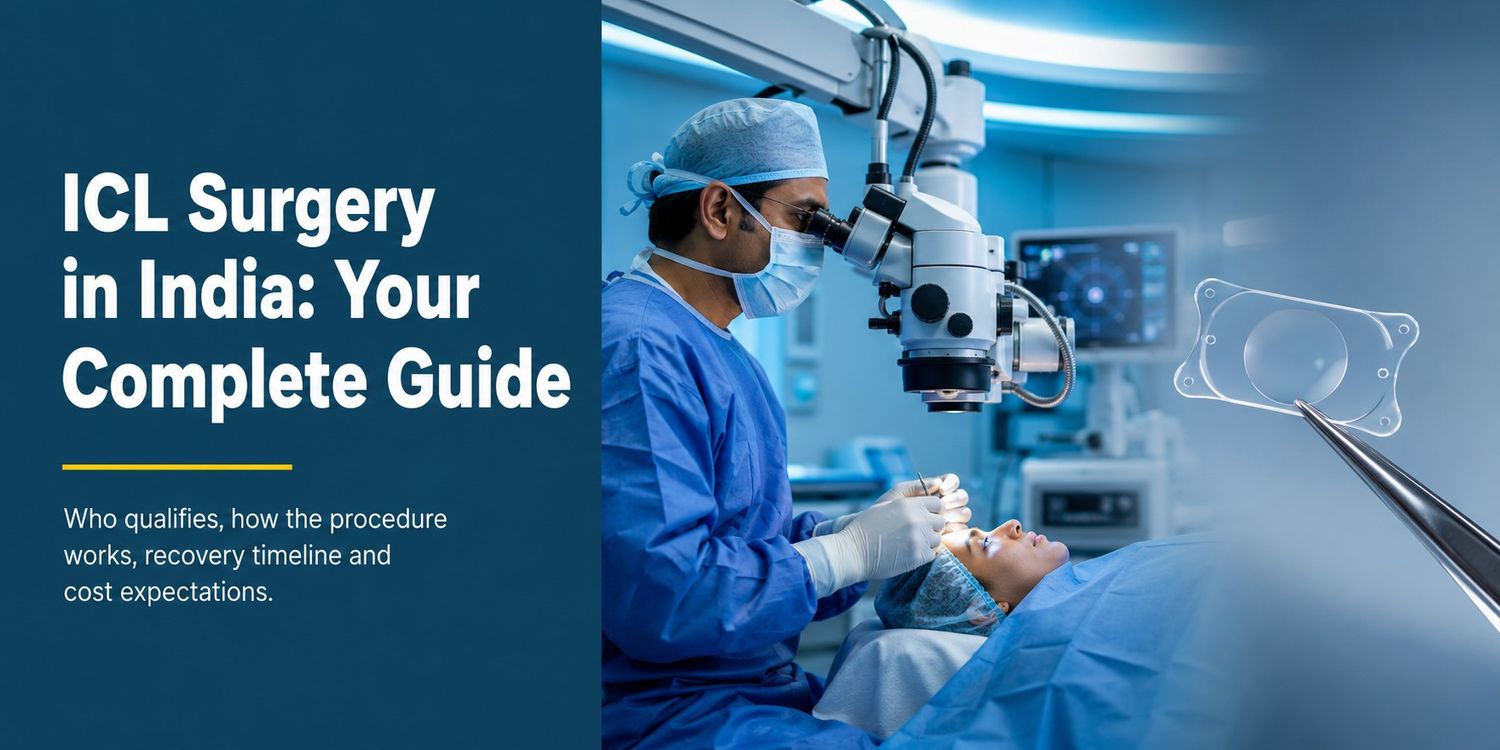
ICL Surgery India: Are You a Candidate? Eligibility, Procedure & Results
Written by

Dr. Aditi Sapovadia
Peadiatric Ophthalmologist & Squint Surgeon
Implantable Collamer Lens (ICL) surgery is a vision correction treatment in which a collamer lens is inserted into the eye. This biocompatible lens is designed to be safe for the eye’s delicate structures. ICL eye surgery is common for people who are not eligible for LASIK or SMILE, often due to thin corneas.
What Is ICL Surgery? Understanding Implantable Collamer Lens
Implantable Collamer Lens (ICL) surgery is a refractive eye surgery used to treat vision defects such as myopia (nearsightedness), hyperopia, and astigmatism. It involves placing a thin lens between the iris and the natural lens. As it does not remove corneal tissue, it is suitable for patients who have thin corneas.
The lens has Collamer, a soft, flexible polymer, which is well tolerated by the eye. ICL surgery is reversible and gives clear vision. It is a quick operation with fast healing and minimal pain.
How ICL Eye Surgery Differs from LASIK and SMILE
Unlike LASIK and PRK, in which the cornea is reshaped, ICL eye surgery involves inserting a thin, flexible lens between the eye’s natural lens and the iris. The implantation does not affect the corneal structure; it enhances the vision.
Collamer, the material with which ICL lenses are made, is biocompatible. This implies that it is easily absorbed by the human body. This reduces the risk of complications as compared to other types of corrective eye treatments.
The Implantable Collamer Lens (ICL) eye surgery is particularly useful to individuals who are not eligible for LASIK eye treatment.
Who Is Eligible for ICL Eye Surgery?
- Individuals without serious eye diseases: A history of serious eye conditions, like glaucoma or cataracts, can disqualify someone from ICL eye surgery.
- Those with thin corneas: ICL provides a safe alternative for individuals who cannot undergo LASIK due to thin or irregular corneas.
- Patients between 21 and 45 years old: ICL surgery is often recommended for this age group, as their prescriptions are generally stable.
- Individuals with significant vision impairments: ICL eye treatment offers a solution for those with severe myopia or astigmatism, conditions often unaddressed by LASIK. Individuals with extreme myopia (-3D to -20D) and hyperopia (+3D to +10D).
- For those seeking reversible options: The ICL's removable nature makes it a flexible choice for anyone considering vision correction.
ICL surgery is suitable for those with dry eyes, as it does not create postoperative dryness.
ICL Surgery Age Limit: Ideal Candidate Profile
The typical age range for ICL eye surgery is
- Minimum age: 18 years.
- Ideal age range: 21-45 years.
- Maximum age: 50 years (depending on eye condition)
Before age 21, power is often unstable. After age 45, presbyopia or early cataracts may limit this eligibility.
ICL vs LASIK: Which Vision Correction Is Right for You?
When discussing clear, glasses-free vision, the debate of ICL vs LASIK has become one of the very important conversations in modern ophthalmology. Both procedures offer life-changing results. The right one for you will depend entirely on your individual anatomy, prescription, and long-term visual goals.
Feature | LASIK | ICL LASER TREATMENT |
Technology | A laser reshapes the cornea. | An implantable lens placed inside the eye |
Reversibility | Permanent | Reversible |
Suitability | Normal cornea, moderate power | Thin cornea, high power |
Dry Eye Risk | May cause dryness | No dryness (cornea untouched) |
UV Protection | No UV protection
Not Sure About Your Diagnosis? Book Your Appointment Now!
| Provides built-in UV protection |
Vision Quality | Predictable, high-quality visual outcomes | Sharper and clearer vision |
Step-by-Step ICL Surgery Procedure
ICL eye surgery is a relatively quick procedure, typically taking around 15 to 20 minutes per eye. It’s a quick laser eye surgery. What sets it apart from other vision correction options is its minimally invasive nature, and it’s done on an outpatient basis
1. Pre-Surgery Evaluation and Tests
A comprehensive eye test is done before the operation. The test would allow determining your visual health, the corrective power that you need, and whether you would be a good candidate to undergo the process.
Your surgeon can also tell you not to wear the contact lenses a few weeks before the surgery. The reason is that contact lenses will alter the cornea structure temporarily. Eye measurements are also taken to ascertain the right size of the lens, eye length, and eye thickness.
2. What Happens During ICL Eye Treatment
ICL laser eye surgery is a very fast, painless operation that usually takes 20-30 minutes. To relieve the pain, a numbing eye solution is applied, and a small opening is made on the cornea.
Using the incision, the Implantable Collamer Lens is then folded and inserted between your iris and the normal lens. When the lens is in position, it unfolds and is focused to give the perfect correction of vision. The wound is self-healing, and no stitches are needed; thus, it can heal faster.
3. Post-Surgery Recovery Timeline
Following ICL eye surgery, you may notice some blurriness or light sensitivity, which is common and temporary. Your eye surgeon will give you eye drops to help you recover and prevent infection.
A follow-up appointment is usually planned the day after surgery to assess recovery and check for any complications from ICL laser eye surgery. Most people notice improved vision after a day or two. The recovery time after ICL surgery is often quick, with most patients returning to regular activities within just two to three days.
Is ICL Surgery Safe? Success Rates and Clinical Evidence
Yes, ICL surgery is FDA-approved and has a proven track record of safety and efficacy for vision correction in suitable candidates. The biocompatible lens has no adverse responses and is designed to last a lifetime, though long-term monitoring is recommended.
ICL surgery has a good success rate, and most patients end up with very good vision, usually 20/20 or even better.
The procedure is very safe and doesn’t change the structure of the cornea very much. Better lens design has improved safety while reducing the likelihood of issues.
Disadvantages and Side Effects of ICL Surgery
Even though ICL eye surgery has a high success rate and good safety, it is important to know about the possible adverse effects and complications, though they are not common. The probability of negative outcomes is rather low, as in any surgical procedure.
The side effects that ICL surgery may have are
- Infection
- Increased eye pressure
- Cataract formation
- Lens dislocation
- Night glare or halos
The disadvantages of ICL eye surgery are:
A key difference between mature and immature cataracts is that the retina can still be visualised in immature cases but not in mature ones. Early detection of cataracts is more than just convenient; it can significantly improve treatment outcomes and quality of life. The mature and immature cataracts are diagnosed by
- Higher Cost Slightly more expensive than LASIK and PRK due to the advanced lens used.
- Surgical Risks Like any eye procedure, there are minimal risks, but serious complications are rare.
- Reading Glasses May Still Be Needed - People above 45 years may still need reading glasses for near vision.
ICL Surgery Cost in India: What to Expect
The cost of ICL surgery in India varies based on the complexity of the case, the location, and the surgeon’s experience.
The typical cost of ICL surgery in India is around ₹1.7-₹2 lakhs for both eyes.
Life After ICL: Long-Term Results and Eye Care Tips
ICL surgery gives patients high-power, clear, as well as stable vision for a long time. Most people have better sight, and their vision does not diminish with age. The cornea is never damaged, which means that such issues as dry eyes are less probable. The lens in the eye is safe and does not require any maintenance.
After ICL, here are some guidelines for caring for your eyes:
- Schedule frequent eye checkups to monitor your health.
- Keep your eyes clear and avoid rubbing them.
- Use the eye drops suggested by your doctor.
- Shield your eyes against dust and the harmful UV rays.
- Contact the doctor as soon as you have any related problems that are of concern, such as blurred vision or pain.
ICL laser surgery is safe, reliable, and long-lasting and has to be taken care of well and with frequent check-ups.
Frequently Asked Questions
What is the age limit for ICL surgery in India?
In India, the usual age threshold for ICL eye surgery begins at 18. The best candidates are often between 21 and 45, though the procedure can be performed on those up to about 50, depending on their specific eye condition.
Is ICL surgery better than LASIK for high power?
Both ICL and LASIK have their advantages. ICL may be a preferable option for patients with high prescriptions or thin corneas because it does not reshape the cornea like LASIK. ICL is also reversible, providing choices if your eyesight changes.
What are the disadvantages of ICL surgery?
Some drawbacks of ICL laser eye surgery include higher cost, surgical risks, potential glare, the need for reading glasses for close-up vision in some cases, and no treatment for presbyopia.
How long does ICL surgery recovery take?
In the first 24 hours, mild discomfort, light sensitivity, and slightly hazy vision may occur; within 48 hours, a significant improvement in vision is usually noticeable; and over the next 1 week to 1 month, vision typically stabilises as the eyes adapt to the new lens.
Is ICL surgery safe for thin corneas?
Yes, ICL surgery is considered safe for patients with thin corneas.