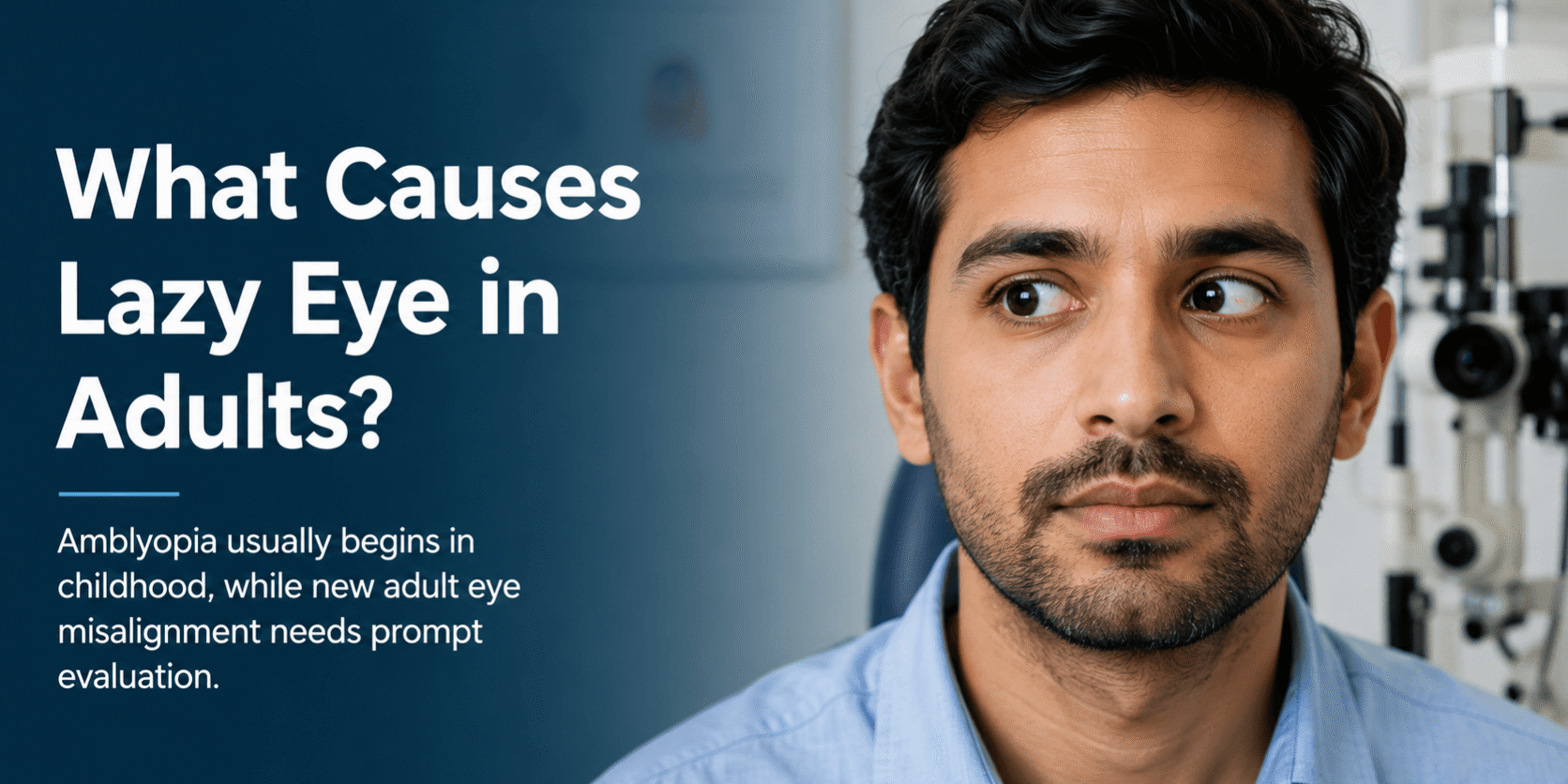
What Causes Lazy Eye in Adults? Causes and Key Facts
What causes lazy eye in adults? The term “lazy eye” usually refers to amblyopia, a condition in which vision in one eye does not develop normally, even though the eye itself may appear healthy. Amblyopia most often begins during childhood, but adults may notice reduced vision, poor depth perception, or an eye that appears to wander.
It is important to distinguish amblyopia from strabismus, commonly called crossed or misaligned eyes. Strabismus can cause amblyopia during childhood, but an eye that becomes misaligned for the first time in adulthood may have a different underlying cause and should be evaluated promptly.
What Causes Lazy Eye in Adults?
True amblyopia generally develops during childhood rather than suddenly in adulthood. However, adults may discover that they have longstanding amblyopia that was never diagnosed or treated.
Common causes include:
Unequal Vision Between the Eyes
When one eye has significantly more nearsightedness, farsightedness, or astigmatism than the other, the brain may rely more heavily on the clearer eye during childhood. Over time, the weaker eye may develop reduced vision.
Misaligned Eyes
Strabismus occurs when the eyes do not point in the same direction. If this begins during childhood, the brain may suppress information from one eye to avoid double vision, potentially leading to amblyopia.
Vision Obstruction During Childhood
Conditions that prevent clear images from reaching the brain during early visual development can contribute to amblyopia. Examples include cataracts present in childhood, drooping of the upper eyelid, or other problems that block vision.
Amblyopia That Was Not Treated in Childhood
Some adults have reduced vision from amblyopia that began when they were young but was never recognized. They may only become aware of the difference between their eyes during a routine eye examination or after an injury or illness affects their stronger eye.
Can Lazy Eye Develop Suddenly in Adults?
Amblyopia itself does not typically develop suddenly in an adult. If an adult develops a newly wandering eye, double vision, sudden blurred vision, or a noticeable change in eye alignment, it should not automatically be assumed to be lazy eye.
New eye misalignment can have several possible causes, including problems affecting the eye muscles, nerves, or other parts of the visual system. An ophthalmologist can determine the underlying cause through a comprehensive eye examination.
How is Lazy Eye Diagnosed?
An eye specialist may check visual acuity in each eye, eye alignment, eye movements, focusing ability, and the health of the eyes. Depending on the findings, additional testing may be recommended.
Diagnosis is particularly important when vision changes or eye misalignment appear for the first time in adulthood because other eye or neurological conditions may need to be ruled out.
Can Lazy Eye Be Treated in Adults?
Treatment depends on whether the person has true amblyopia, strabismus, or another condition causing reduced vision or eye misalignment.
Treatment may include prescription glasses or contact lenses, management of an underlying eye condition, or treatment for strabismus. Some adults with amblyopia may experience improvement with appropriately supervised treatment, although the amount of improvement varies and treatment is generally more effective when started during childhood.
An ophthalmologist can recommend an appropriate treatment plan after identifying the cause and assessing the vision in each eye.
When Should You See an Eye Specialist?
Adults should arrange an eye examination if they notice:
- A new change in eye alignment
- Double vision
- Sudden or unexplained vision changes
- Persistent blurred vision in one eye
- Difficulty judging distances
- A noticeable difference in vision between the two eyes
- An eye that appears to wander or turn
Sudden vision loss, sudden double vision, or a new eye movement problem requires prompt medical evaluation.
Key Takeaways
- What causes lazy eye in adults? True amblyopia usually begins during childhood rather than developing suddenly in adulthood.
- Unequal vision between the eyes, childhood strabismus, and conditions that interfere with early visual development can cause amblyopia.
- Adults may discover previously untreated amblyopia later in life.
- New eye misalignment in adulthood should not automatically be considered lazy eye.
- An ophthalmologist can determine whether reduced vision is due to amblyopia, strabismus, or another eye condition.
- Early evaluation is important when an adult develops new or sudden changes in vision or eye alignment.
Conclusion
Understanding what causes lazy eye in adults starts with recognizing that amblyopia usually originates during childhood, even when it is discovered much later. Adults with reduced vision in one eye or a new change in eye alignment should have a comprehensive eye examination rather than assuming the problem is simply a lazy eye.
A qualified ophthalmologist can identify the underlying cause and explain whether treatment may help improve vision or eye alignment.