What Is Phacoemulsification Cataract Surgery?
Cataracts are one of the most common eye problems seen in adults above 50 in India. The lens inside your eye becomes cloudy over time, and vision starts getting blurry or hazy. The only proper treatment is surgery, and today, the most widely used method for this is phacoemulsification cataract surgery. If your doctor has recommended this surgery and you are not sure what it involves, this blog explains everything in simple, straightforward terms.
What Is Phacoemulsification? Understanding the Basics of Phaco Eye Surgery
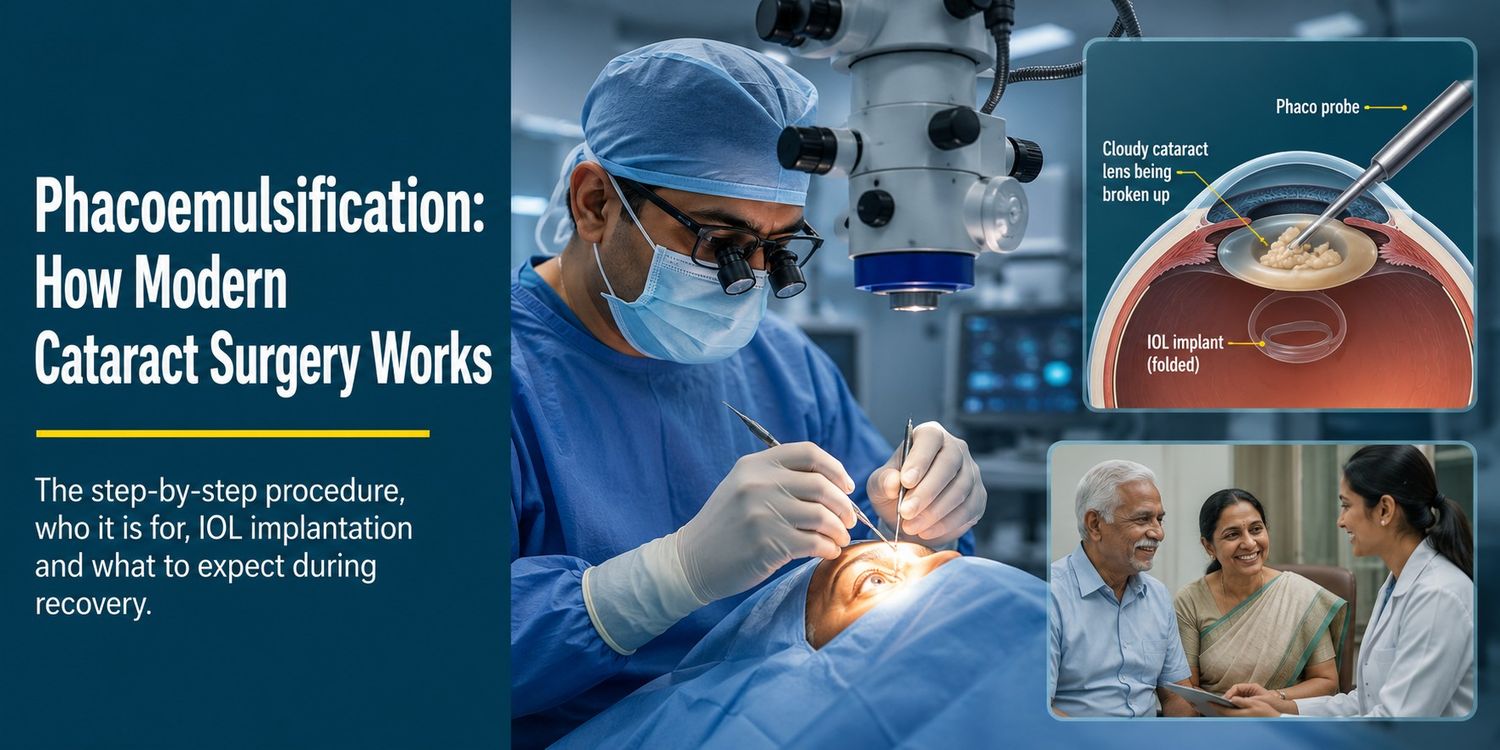
Phacoemulsification, most doctors and patients just call it “phaco”, is a cataract removal technique where the cloudy lens is broken into tiny pieces using ultrasound energy and then removed through a very small cut in the eye. Once the cloudy lens is out, a clear artificial lens (called an intraocular lens or IOL) is placed in its position.
Before this technique became common, cataract surgery required a much larger incision and longer healing time. Phaco changed that completely. The cut is so small, usually around 2 to 3 millimetres, that it often does not even need stitches. This is why it has become the standard approach in most eye hospitals across the world, including India.
The procedure is done under local anaesthesia, meaning you are awake, but your eye is completely numb. It usually takes less than 30 minutes per eye.
How the Phacoemulsification Procedure Works Step by Step
Understanding what actually happens during the phacoemulsification cataract surgery can help ease the anxiety many patients feel before the procedure.
Small Incision Cataract Surgery: Creating the Entry Point
The surgeon begins by making a tiny self-sealing cut on the side of the cornea, the clear front part of your eye. A second, even smaller cut may be made nearby. Through these openings, the surgeon inserts fine instruments. Because the incision is so small, it typically closes on its own after surgery without needing sutures.
A substance called viscoelastic is injected into the eye to maintain its shape during the procedure. Then, the surgeon carefully removes the front portion of the capsule (the thin membrane surrounding the lens) in a circular manner. This step is called capsulorhexis and requires good precision.
Ultrasound Cataract Surgery: How Sound Waves Break Down the Lens
This is the central step of the whole procedure. A thin probe is inserted into the eye. This probe vibrates at ultrasonic frequency, thousands of times per second, and this vibration breaks the hard, cloudy lens into very small fragments. As the lens breaks apart, it is simultaneously suctioned out through the same probe.
The energy used is controlled very carefully. Modern phaco machines really help the surgeons so that they can adjust the settings depending on how much is the hardness or softness of the cataract. This makes the procedure safer and reduces the stress on surrounding eye tissues.
IOL Implantation Surgery: Placing the Artificial Lens
then it acts as a support structure for the new artificial lens. The IOL is folded (since it is soft and flexible) and inserted through the same small incision. Once inside the eye, it unfolds and settles into position. No sutures are generally needed. The whole eye structure remains stable, and vision correction begins almost immediately.
Phacoemulsification Recovery Time: What to Expect Day by Day
Recovery after phaco surgery is generally smooth compared to older cataract techniques.
On the day of surgery, you will have an eye pad or shield placed over the operated eye. Vision may be blurry for a few hours, which is normal. You should arrange for someone to take you home; you cannot drive.
By the next day, most patients notice a clear improvement in vision. There is usually some mild redness or a gritty feeling in the eye, but pain is rarely severe. Your doctor will prescribe antibiotic and anti-inflammatory eye drops, which you need to use regularly for a few weeks.
By the end of the first week, most people can return to light activities, including reading, watching TV, and working at a desk. Avoiding dusty environments, rubbing the eye, and strenuous physical activity is advised for two to four weeks.
Full visual stability usually settles within four to six weeks. If you have chosen a monofocal IOL (explained later), you may still need reading glasses for close work. Your doctor will prescribe final glasses after the eye stabilises.
Why Phacoemulsification Is Classified as Minimally Invasive Cataract Surgery?
The term minimally invasive simply means the surgery involves very little disruption to the body compared to traditional methods. In phaco, the incision is so small that it self-seals. There is no major cutting, no long wound to heal, and no hospital stay required.
This has several practical benefits. The risk of post-operative infection is lower because the eye is not open for long. Recovery time is significantly shorter. Patients can resume normal life faster. And because the eye structure is not disturbed much, the IOL sits in a very stable way, and vision outcomes are generally very predictable.
This is one reason phacoemulsification cataract surgery has been so much preferred in most urban eye hospitals across India and globally.
Phacoemulsification Complications: Risks and How They Are Managed
The artificial lens placed inside your eye is a permanent one. It does not need to be replaced under normal circumstances. But there are different types, and the right choice depends on your lifestyle, budget, and how well your eyes are otherwise.
A monofocal IOL gives clear vision at one distance, usually far. You will likely still need reading glasses for close work. This is the standard option covered under most insurance plans and government schemes.
Multifocal IOLs are designed to give clarity at more than one distance, near, intermediate, and far. Many patients with these lenses become less dependent on glasses altogether. However, some people notice halos or glare around lights, especially at night, particularly in the early months.
Toric IOLs are designed for people who have astigmatism along with cataract. They correct the astigmatism during the same surgery, reducing dependence on glasses after recovery.
Your surgeon will measure your eye precisely before surgery and help you pick the most suitable lens. The right IOL is the one that matches your eye measurements and your daily visual needs.
Frequently Asked Questions: About Phacoemulsification Cataract Surgery
Is phacoemulsification safe for all age groups?
Yes, generally. Phacoemulsification cataract surgery is performed safely in patients from their 40s to well into their 80s and beyond. Age alone is not a disqualifying factor. What matters more is the overall health of the eye and the presence of other eye conditions like glaucoma or retinal disease, which may affect the outcome. Diabetic patients may also need additional monitoring, but can usually undergo the procedure safely.
How long does phacoemulsification surgery take?
In most cases, the actual phacoemulsification cataract surgery takes between 15 and 30 minutes per eye. The time in the hospital, including preparation and observation after the procedure, may be two to three hours in total. Patients are usually sent home the same day.
What is the recovery time after phaco eye surgery?
Basic recovery, where you can manage daily activities comfortably, happens within a week for most patients. Vision continues to improve and stabilise over four to six weeks. The eye drops need to be continued for the full prescribed period, even if the eye looks and feels fine earlier.
Can phacoemulsification be done on both eyes the same day?
Most surgeons in India prefer to operate on one eye at a time, with a gap of one to two weeks between the two surgeries. This allows the first eye to recover and confirm that there are no issues before the second eye is operated on. In exceptional circumstances, both eyes may be done on the same day, but this is not the standard practice.
What happens if phacoemulsification complications occur?
If something does not go as expected during phacoemulsification cataract surgery, your surgeon manages it immediately. Most intraoperative issues are handled in the OT itself. For post-operative problems like raised pressure, swelling, or infection, you will be called for a follow-up and treated with appropriate medications. Serious vision-threatening complications are uncommon when the surgery is done by an experienced ophthalmologist in a well-equipped facility.