SMILE Surgery vs LASIK: Technology Comparison
Many people who want to get rid of their glasses end up searching online for hours trying to figure out whether SMILE or LASIK is the right option. Both are laser-based procedures that correct vision, but they work quite differently. And the “better” one honestly depends on your eye profile, lifestyle, and what your doctor finds during the pre-surgery evaluation.
This article breaks down both procedures clearly so you can have a more meaningful conversation with your eye surgeon.
What Is LASIK Surgery? How It Works and What It Corrects
LASIK surgery, which means Laser-Assisted In Situ Keratomileusis, has been around since the 1990s and is still one of the most widely performed vision correction procedures in the world. In India, it has been available for over two decades and lakhs of people have undergone it successfully.
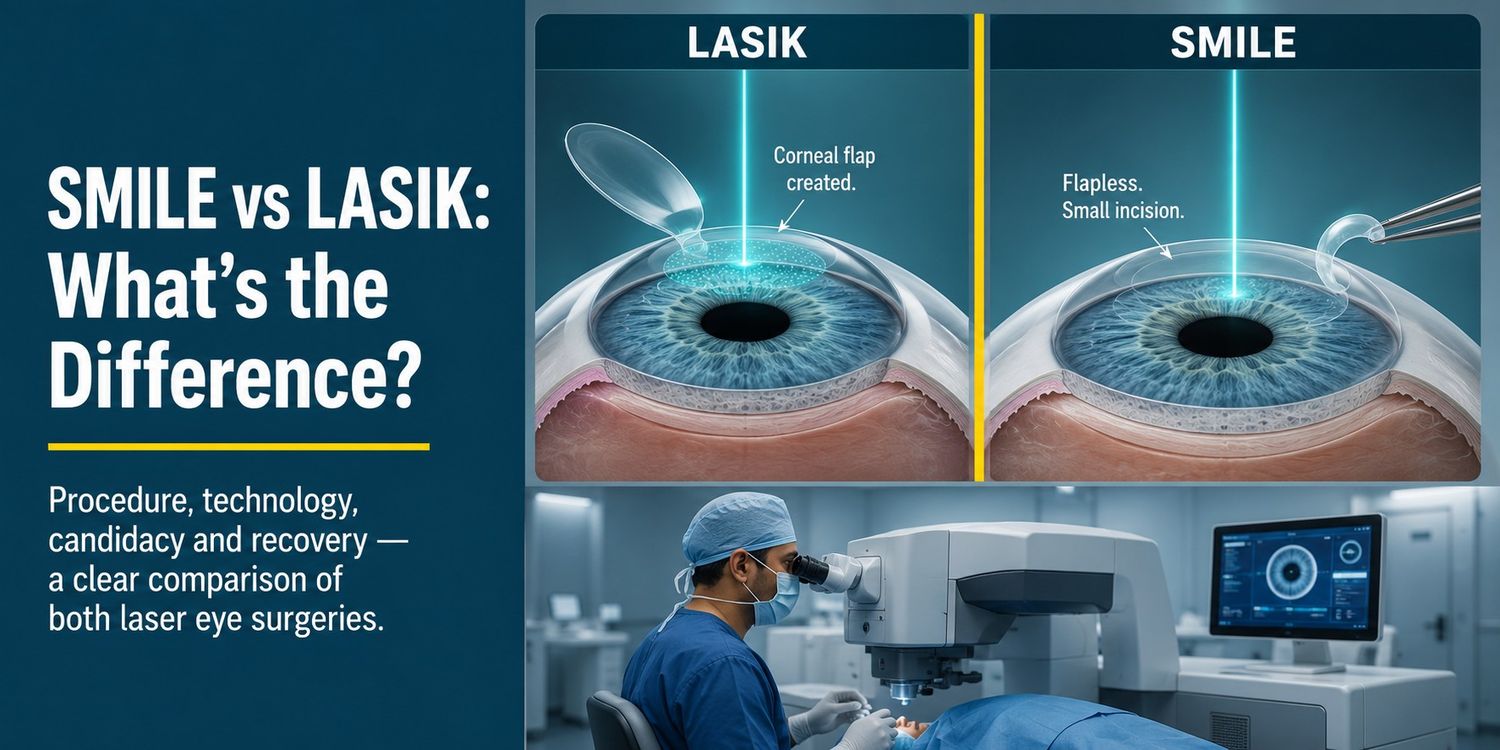
The procedure works in two main steps. First, a thin flap is created on the surface of the cornea, either using a mechanical blade (in older versions) or a femtosecond laser (in bladeless LASIK). This flap is lifted to expose the inner corneal tissue. Then, an excimer laser reshapes the cornea precisely based on your prescription. After reshaping, the flap is placed back. It adheres naturally without any stitches.
LASIK corrects myopia (short-sightedness), hyperopia (long-sightedness), and astigmatism. It is suitable for a wide range of prescriptions, and the visual recovery is quite fast; most patients see clearly within 24 to 48 hours.
What Is SMILE Eye Surgery? The Science Behind Small Incision Lenticule Extraction
SMILE, Small Incision Lenticule Extraction, is a newer laser procedure. It was introduced commercially around 2011 and has steadily gained popularity, especially in the last five to seven years in India.
Unlike LASIK, SMILE does not involve creating a corneal flap. Instead, a femtosecond laser creates a small disc-shaped piece of corneal tissue inside the cornea; this is called a lenticule. A small arc-shaped cut (about 2 to 4 mm) is made on the surface of the cornea. The surgeon then removes the lenticule through this tiny opening. Removing this piece of tissue changes the shape of the cornea and corrects vision.
The whole thing is done with a single laser; there is no second laser step involved. Because no flap is created, the corneal structure is more intact compared to LASIK.
Currently, SMILE is primarily used to correct myopia and myopia with astigmatism. It is not yet approved for hyperopia in most countries.
SMILE Surgery for Myopia: How Effective Is It Compared to LASIK?
Both SMILE and LASIK produce excellent results for myopia correction. Studies comparing the two show that final visual acuity outcomes are largely similar; most patients achieve 6/6 or better vision with either procedure.
Where SMILE tends to do slightly better is in patients with higher myopia (say, above -6 dioptres). Since the corneal surface remains more intact, there is less biomechanical impact on the eye. For people with thin corneas or those involved in high-contact sports, this can be an advantage.
However, LASIK also has a very well-established track record. The volume of long-term data on LASIK outcomes is far more than what currently exists for SMILE, simply because LASIK has been done for much longer. For moderate myopia, many surgeons feel both procedures are equally effective.
LASIK vs SMILE: Which Is Better? A Head-to-Head Comparison
Procedure Differences Between SMILE vs LASIK Eye Surgery
The most fundamental difference is the flap. LASIK creates a flap; SMILE does not. In LASIK, the flap is created and lifted, the underlying cornea is reshaped, and the flap is repositioned. In SMILE, the tissue is extracted through a small keyhole-like incision without disturbing the surface.
LASIK uses two lasers: a femtosecond laser to create the flap and an excimer laser to reshape the cornea. SMILE uses only one laser for the entire procedure.
Because SMILE does not cut the surface nerves of the cornea as much as LASIK does, it tends to cause less disruption to corneal sensitivity. This is one of the reasons SMILE patients generally report better comfort in the post-operative period, particularly in terms of dryness.
Recovery, Comfort and Healing Time
With LASIK, vision improves dramatically within the first day or two. Most patients are back to work in two to three days. There can be some dryness, glare, or halos in the initial weeks, but these usually settle.
With SMILE, the visual recovery is slightly slower in the first few days compared to LASIK. Some patients notice that it takes about a week before vision is fully sharp. However, SMILE patients generally experience less dryness and discomfort during recovery because fewer corneal nerves are cut in the process.
Both procedures require you to avoid swimming, rubbing your eyes, and strenuous activity for a few weeks. Follow-up visits are important for both.
Which Eye Surgery Is Best for Specs Removal?
There is no universal answer here. For someone with moderate myopia, good corneal thickness, and no dry eye issues, both procedures can give excellent results. If you are someone who plays contact sports, works in dusty environments, or has a slightly thinner cornea, SMILE may be the better choice because there is no flap that can get displaced.
If you have hyperopia or a complex prescription that includes farsightedness, LASIK remains the only laser option currently. SMILE does not correct hyperopia yet.
From a specs removal perspective, the more important thing is proper screening, making sure your cornea is suitable, your prescription is stable, and your eye measurements meet the criteria. Which procedure you then get is a secondary decision.
Who Is the Ideal Candidate for SMILE and Who Should Choose LASIK?
SMILE may suit you better if:
- Your myopia is on the higher side (above -5 or -6 dioptres)
- You have mild to moderate dry eye symptoms
- Your corneal thickness is adequate, but on the lower side of normal
- You are physically active, and there is a risk of eye trauma (contact sports, martial arts, etc)
- You prefer a flapless procedure for any reason
LASIK may suit you better if:
- You have hyperopia or mixed astigmatism
- You want faster visual recovery
- Your prescription is within a moderate range
- Budget is a significant consideration (LASIK is generally more affordable)
- You have already been evaluated and found suitable by an experienced refractive surgeon
In both cases, the final call should be made after a thorough pre-operative evaluation that includes corneal mapping (topography), corneal thickness measurement, dry eye assessment, and other tests.
Cost Comparison: SMILE vs LASIK in India
Cost is a real factor for most patients in India, and it is worth understanding the difference.
LASIK (bladeless, femto-LASIK) typically costs anywhere between Rs. 25,000 to Rs. 45,000 per eye, depending on the city, hospital, and technology being used.
SMILE surgery costs more, generally between Rs. 50,000 and Rs. 90,000 per eye at the most reputed eye hospitals. The higher cost is because SMILE requires more advanced equipment (the VisuMax laser system from Zeiss is currently the most widely used platform for SMILE), and the procedure itself has fewer machines available in India compared to LASIK platforms.
So if someone is choosing purely on affordability and is medically suitable for both, LASIK tends to be the more cost-accessible option. But if a surgeon recommends SMILE based on your eye profile, it is usually worth considering seriously rather than just going with the cheaper option.
Frequently Asked Questions: Difference Between SMILE and LASIK
What is the main difference between SMILE and LASIK?
The main difference is in how the cornea is treated. LASIK creates a flap on the corneal surface and then uses a second laser to reshape the tissue underneath. SMILE skips the flap entirely; a small piece of corneal tissue (lenticule) is created inside the cornea using a single laser and then removed through a tiny incision.
Is SMILE eye surgery painful?
No, the procedure itself is not painful. Your eyes are numbed with anaesthetic drops before the surgery begins. Patients may feel slight pressure during the procedure, but no sharp pain. After the surgery, some patients feel mild discomfort, watering, or a gritty sensation for a day or two; this is normal.
Which lasts longer, SMILE or LASIK results?
Both procedures permanently reshape the cornea, so the correction is long-lasting for both. Regression can happen with either procedure, especially in higher prescriptions. Based on long-term LASIK data, results remain stable for most patients for many years. SMILE has shown similarly stable results in medium-term follow-up studies, though it has not been around long enough to have 20-year data the way LASIK does.
Can you get SMILE surgery if you have dry eyes?
Dry eye is one of the reasons many patients are specifically pointed towards SMILE over LASIK. Because SMILE cuts fewer corneal nerves, the impact on tear production and corneal sensation is lower, which means dry eye symptoms after surgery tend to be milder.
Is SMILE surgery available across all Maxivision centres?
SMILE surgery is available at select Maxivision centres that are equipped with the required laser technology. Since SMILE requires specific equipment, not every centre in the network may offer it. It is best to contact your nearest Maxivision centre directly or check with their team to confirm availability.